In Young's double slit experiment, light passes through two narrow slits close together. Each slit diffracts the light, so the two beams overlap and interfere, producing a pattern of equally spaced bright and dark fringes on a screen. This was historic evidence that light is a wave.The two slits must act as coherent sources. A laser gives coherent light directly. With an ordinary lamp, light first passes through a single slit so that both double slits are lit from the same wavefront.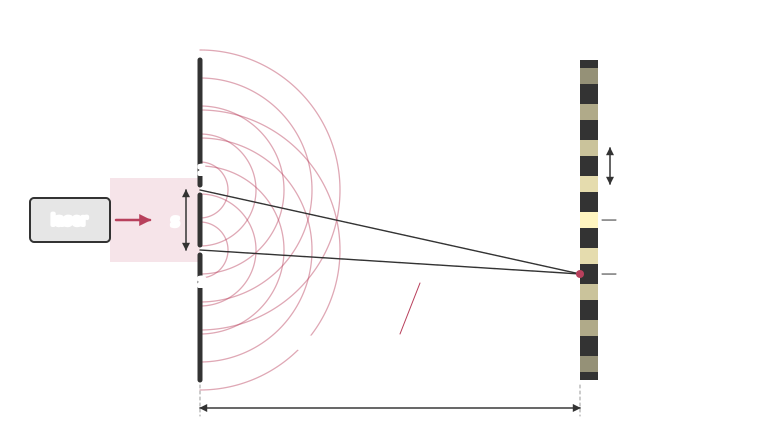
Dark fringe: the path difference is an odd number of half wavelengths, (n + ½)λ, so the waves arrive in antiphase and cancel.The fringe spacing w (distance between adjacent bright fringes) isw = λD / s where D is the slit to screen distance and s is the slit separation. So moving the screen further away or using slits closer together spreads the fringes out, and red light gives wider fringes than blue.Worked example: λ = 600 nm, D = 2.0 m, s = 0.50 mm. w = 600 × 10-9 × 2.0 / 0.50 × 10-3 = 2.4 × 10⁻³ m = 2.4 mm. At the second bright fringe from the centre, the path difference is 2λ = 1200 nm.To measure w accurately, measure across ten fringe spacings and divide by ten.
Dark fringe: the path difference is an odd number of half wavelengths, (n + ½)λ, so the waves arrive in antiphase and cancel.The fringe spacing w (distance between adjacent bright fringes) is