Refraction is the change in direction of a wave when it passes from one medium into another and changes speed.Light travels fastest in a vacuum (c = 3.00 × 10⁸ m s-1) and slower in materials such as water and glass. When a ray of light enters a slower material at an angle to the boundary, it bends. Angles are measured from the normal, a line drawn at 90° to the boundary where the ray meets it.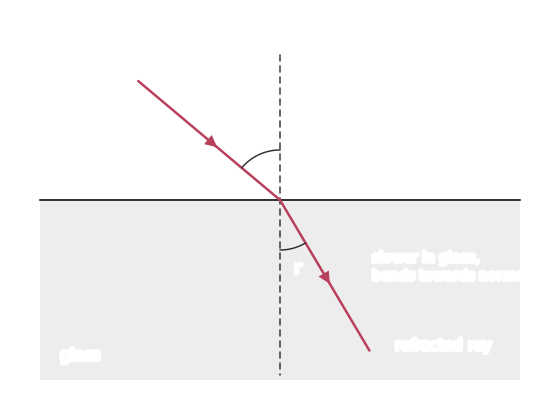
Entering a faster (less dense) material, such as glass to air, the ray bends away from the normal.
Along the normal: a ray meeting the boundary at 90° changes speed but not direction.The frequency of the wave does not change, because it is set by the source. Since v = fλ, when the speed falls the wavelength gets shorter.How much a material slows light is given by its absolute refractive index:n = c / v where v is the speed of light in the material. n has no units and is always at least 1. For air, n is 1.00 to three significant figures.Worked example: light travels at 2.25 × 10⁸ m s-1 in water. n = 3.00 × 10⁸ / 2.25 × 108 = 1.33. In glass of n = 1.50, light travels at 3.00 × 10⁸ / 1.50 = 2.00 × 10⁸ m s-1.
Entering a faster (less dense) material, such as glass to air, the ray bends away from the normal.
Along the normal: a ray meeting the boundary at 90° changes speed but not direction.The frequency of the wave does not change, because it is set by the source. Since v = fλ, when the speed falls the wavelength gets shorter.How much a material slows light is given by its absolute refractive index: