Diffraction is the spreading out of waves as they pass through a gap or travel past the edge of an obstacle.All types of wave diffract: water waves, sound, light and other electromagnetic waves. Diffraction is a property of waves, so observing it is strong evidence that something behaves as a wave.In a ripple tank, straight (plane) wavefronts approach a barrier with a gap. Beyond the gap, the wavefronts curve and spread into the region behind the barrier that they could not reach if they travelled only in straight lines.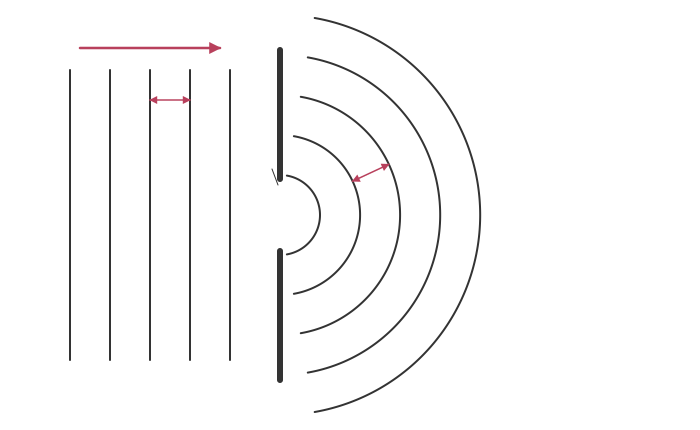
You can hear someone talking in the next room through an open door, even when you cannot see them.
Radio waves diffract around hills and buildings.
Light diffracts through narrow slits and around tiny objects, producing patterns of light and dark. This showed that light is a wave.Diffraction of particles is important too. When a beam of electrons passes through a thin crystal or graphite film, it produces a diffraction pattern of rings. This is evidence that electrons have wave properties, an idea met again in the topic on the nature of light and matter.Worked example: ripples of frequency 5.0 Hz and wavelength 2.0 cm pass through a gap. They travel at v = fλ = 5.0 × 2.0 = 10 cm s-1 before and after the gap.