Skip to content

Investigating the Factors Affecting Fundamental Frequency

This practical investigates how the fundamental frequency of a string depends on its length, tension and mass per unit length.Apparatus: a string is tied to a vibration generator, passes over a wooden bridge and a pulley at the edge of the bench, and has a mass hanger on the end. The vibration generator is driven by a signal generator. The tension equals the weight of the hanging masses, T = mg. The vibrating length l is from the vibration generator to the bridge.
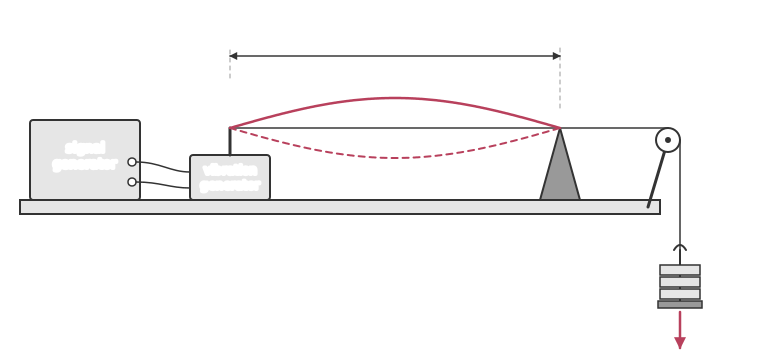
Method: start at a low frequency and increase it slowly until the string vibrates in one loop with maximum amplitude. Read the fundamental frequency from the signal generator. Measure l with a metre rule.Length: keep T constant and move the bridge to change l. Theory predicts f ∝ 1/l, so a graph of f against 1/l is a straight line through the origin.Tension: keep l constant and add masses. Theory predicts f ∝ √T, so a graph of f against √T is a straight line through the origin.Mass per unit length: use strings of different μ (weigh a measured length of each) at the same l and T. Heavier strings give lower frequencies.Improving results: judge the maximum amplitude by approaching the frequency from above and below, and repeat readings. A strobe can help see the loop clearly.Safety: wear eye protection in case the string snaps, and keep feet clear of the hanging masses.Worked example: hanging 0.100 kg gives T = 0.100 × 9.81 = 0.981 N.

Read the text

Read the text and highlight anything you think is important. When you go on, the text is hidden and you answer from memory.

Specification: Edexcel Physics (8PH0), AS-level, Topic 5: Waves and Particle Nature of Light, statement 69. Topic: Waves.

Key terms in this lesson

vibration generator
A device that vibrates a string or wire at a chosen, adjustable frequency, driven by a signal generator.

More in Waves

All 22 lessons in Waves · All Edexcel AS-level Physics topics