A laser and a diffraction grating can be used to measure the wavelength of laser light accurately.Apparatus: a laser, a diffraction grating of known lines per mm in a holder, and a screen (or wall) about 1 m away. The distance D from the grating to the screen is measured with a metre rule or tape.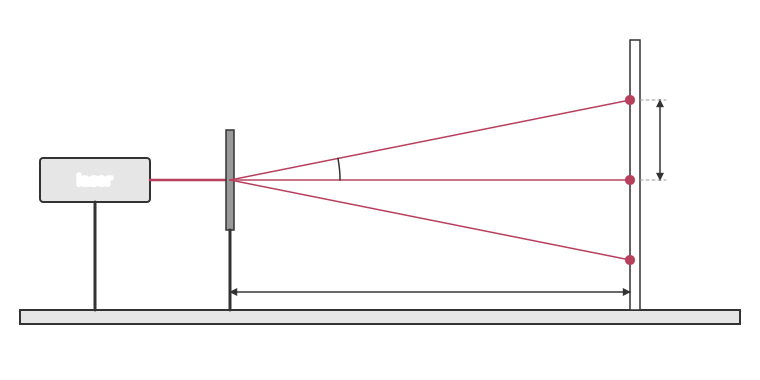
tan θ = x / D and λ = d sin θ / n Repeat for the second and third orders and take a mean. A large D makes x larger, reducing the percentage uncertainty in x.Worked example: a grating has 300 lines per mm, so d = 1 / (3.00 × 10⁵) = 3.33 × 10⁻⁶ m. With D = 1.00 m, the first order maxima are 0.20 m either side of the centre. tan θ = 0.20 / 1.00 = 0.20, so θ = 11.3° and sin θ = 0.196. λ = 3.33 × 10-6 × 0.196 = 6.53 × 10⁻⁷ m = 653 nm (red light).Safety: never look into the laser beam or point it at anyone. Remove reflective objects such as watches and jewellery from the beam path, and keep the beam at bench level.The same set-up with a single slit, or a hair, shows single slit diffraction patterns.