The fundamental frequency f0 is the lowest frequency at which a string forms a stationary wave. It is the first harmonic: one loop, with λ = 2l.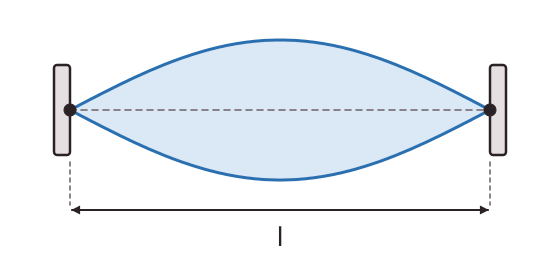 Combining f = v/λ with v = √(T/μ) gives
f0 = (1 / 2l) √(T / μ) This shows how each factor affects the pitch:
Length: a longer string has a lower f0 (f0 ∝ 1/l).
Tension: a tighter string has a higher f0 (f0 ∝ √T).
Mass per unit length: a heavier, thicker string has a lower f0 (f0 ∝ 1/√μ).String instruments use all three. Tuning pegs change the tension. Pressing a string against a fret shortens its vibrating length and raises the note. The low notes come from the thick strings.Worked example: a guitar string is 0.65 m long, under a tension of 60 N, with μ = 1.5 × 10⁻³ kg m-1.
v = √(60 / 1.5 × 10⁻³) = √(40 000) = 200 m s-1
f0 = 200 / (2 × 0.65) = 200 / 1.3 = 154 HzIf the player frets the string to halve its length, f0 doubles to about 308 Hz. To raise the note by the same amount using tension alone, the tension would have to be multiplied by four.
Combining f = v/λ with v = √(T/μ) givesLength: a longer string has a lower f0 (f0 ∝ 1/l).
Tension: a tighter string has a higher f0 (f0 ∝ √T).
Mass per unit length: a heavier, thicker string has a lower f0 (f0 ∝ 1/√μ).String instruments use all three. Tuning pegs change the tension. Pressing a string against a fret shortens its vibrating length and raises the note. The low notes come from the thick strings.Worked example: a guitar string is 0.65 m long, under a tension of 60 N, with μ = 1.5 × 10⁻³ kg m-1.
v = √(60 / 1.5 × 10⁻³) = √(40 000) = 200 m s-1
f0 = 200 / (2 × 0.65) = 200 / 1.3 = 154 HzIf the player frets the string to halve its length, f0 doubles to about 308 Hz. To raise the note by the same amount using tension alone, the tension would have to be multiplied by four.