The amount of diffraction depends on how the size of the gap (or obstacle) compares with the wavelength of the waves.Gap about the same size as the wavelength: diffraction is greatest. The waves spread out through large angles, almost into semicircles.Gap much wider than the wavelength: there is very little diffraction. Most of the wave passes straight through, with only slight spreading at the edges.Gap narrower than the wavelength: the waves still spread widely, but much less energy gets through, so the diffracted waves have a small amplitude.So for a fixed gap, longer wavelengths diffract more. For a fixed wavelength, narrower gaps give more spreading.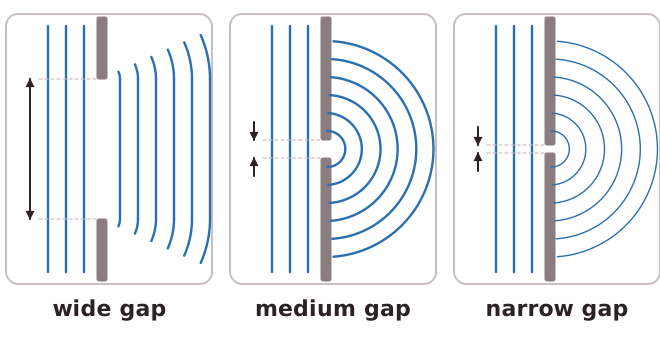 Worked example: sound of frequency 340 Hz travels at 340 m s-1 in air, so λ = 340 / 340 = 1.0 m. A doorway is about 0.8 m wide, similar to the wavelength, so the sound diffracts strongly and can be heard around the corner. Visible light has a wavelength of about 5 × 10⁻⁷ m, over a million times smaller than the doorway, so light passes through with almost no diffraction and you cannot see around the corner.The same idea explains why long-wave radio signals (wavelengths of about 1 km) can be received in valleys behind hills, because they diffract around the hills, while short-wavelength signals such as TV and mobile phone signals need a direct line of sight to the transmitter.To see diffraction of light, you need a gap that is very narrow, close to the wavelength of light.