A diffraction grating is a slide with a very large number of equally spaced, parallel slits (lines), often several hundred per millimetre. When monochromatic light passes through it, light from all the slits interferes to produce a few very sharp, bright maxima at particular angles, with darkness in between.The maxima occur where light from adjacent slits has a path difference of a whole number of wavelengths:nλ = d sin θ where d is the slit spacing (distance between adjacent slits), θ is the angle from the straight-through direction, and n is the order of the maximum (n = 0 for the central, straight-through beam, then 1, 2, 3 ... on each side).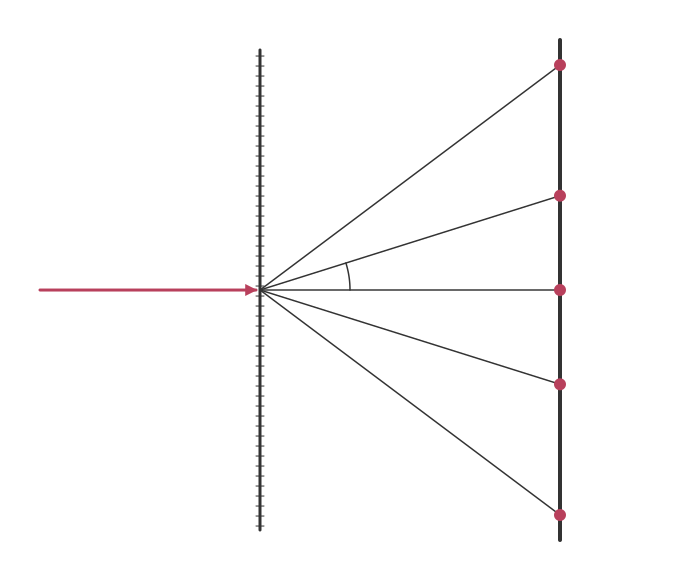
First order: sin θ = 1 × 600 × 10-9 / 2.0 × 10-6 = 0.30, so θ = 17.5°.
Maximum order: d/λ = 3.33, so the highest order is n = 3.Because the maxima are so sharp and widely spread, gratings are used to measure wavelengths accurately and to split light into spectra.
First order: sin θ = 1 × 600 × 10-9 / 2.0 × 10-6 = 0.30, so θ = 17.5°.
Maximum order: d/λ = 3.33, so the highest order is n = 3.Because the maxima are so sharp and widely spread, gratings are used to measure wavelengths accurately and to split light into spectra.