Snell's law links the angles on either side of a boundary to the refractive indices of the two materials:n1 sin θ1 = n2 sin θ2 n1 and θ1 are the refractive index and angle in the first material, n2 and θ2 in the second. Both angles are measured from the normal, not from the surface. For air, n = 1.00.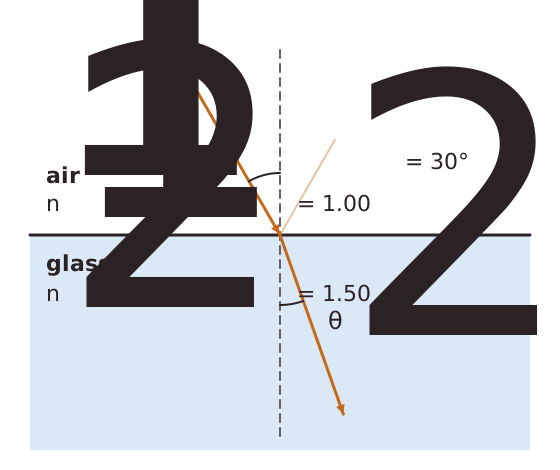 The equation shows that the angle is smaller in the material with the larger refractive index. So light going into a higher n material bends towards the normal, and light going into a lower n material bends away from it.Worked example 1 (air to glass): a ray in air hits glass (n = 1.50) at 30° to the normal.
1.00 × sin 30° = 1.50 × sin θ2
sin θ2 = 0.500 / 1.50 = 0.333, so θ2 = 19.5°.Worked example 2 (glass to water): a ray in glass (n = 1.50) meets water (n = 1.33) at 30°.
sin θ2 = 1.50 × 0.500 / 1.33 = 0.564, so θ2 = 34.3°. The ray bends away from the normal because water has the lower refractive index.Tips: set your calculator to degrees; check your answer makes sense (a bigger angle in the lower n material); and if sin θ2 comes out bigger than 1, no refracted ray exists, which is the case of total internal reflection.
The equation shows that the angle is smaller in the material with the larger refractive index. So light going into a higher n material bends towards the normal, and light going into a lower n material bends away from it.Worked example 1 (air to glass): a ray in air hits glass (n = 1.50) at 30° to the normal.1.00 × sin 30° = 1.50 × sin θ2
sin θ2 = 0.500 / 1.50 = 0.333, so θ2 = 19.5°.Worked example 2 (glass to water): a ray in glass (n = 1.50) meets water (n = 1.33) at 30°.
sin θ2 = 1.50 × 0.500 / 1.33 = 0.564, so θ2 = 34.3°. The ray bends away from the normal because water has the lower refractive index.Tips: set your calculator to degrees; check your answer makes sense (a bigger angle in the lower n material); and if sin θ2 comes out bigger than 1, no refracted ray exists, which is the case of total internal reflection.