Skip to content

Applications of Total Internal Reflection

Total internal reflection (TIR) reflects all of the light, with no loss by refraction, so it has many uses.Optical fibres: a fibre has a glass core surrounded by cladding of slightly lower refractive index. Light entering the end strikes the core-cladding boundary at more than the critical angle, and is totally internally reflected again and again along the fibre, even round gentle bends. The cladding protects the core from scratches (which would let light escape) and stops light crossing between fibres touching each other.
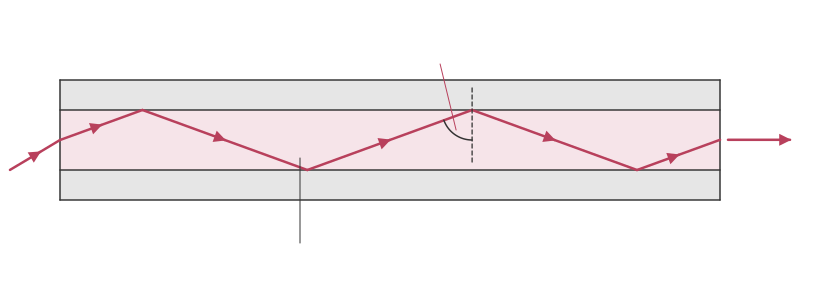
Communications: pulses of light or infrared carry telephone, TV and internet data through fibres. They carry far more data than copper wire, with little loss, and are not affected by electrical interference.Endoscopes: doctors view inside the body with a bundle of fibres. One bundle carries light in. A coherent bundle, where the fibres keep the same arrangement at both ends, carries the image back.Prisms: in periscopes and binoculars, 45° glass prisms turn light through 90° or 180°. Light meets the inside face at 45°, more than the critical angle of about 42° for glass, so it is totally reflected. Prisms give brighter, sharper images than mirrors. Bicycle reflectors and cat's eyes work the same way.Worked example: a fibre has core n = 1.50 and cladding n = 1.40. sin C = 1.40 / 1.50 = 0.933, so C = 69.0°. Light must hit the boundary at more than 69.0° to stay in the core.

Read the text

Read the text and highlight anything you think is important. When you go on, the text is hidden and you answer from memory.

Specification: Edexcel Physics (8PH0), AS-level, Topic 5: Waves and Particle Nature of Light, statement 73. Topic: Optics.

Key terms in this lesson

critical angle
The angle of incidence in the optically denser medium at which the angle of refraction is exactly 90 degrees, the onset of total internal reflection.

More in Optics

All 21 lessons in Optics · All Edexcel AS-level Physics topics