 BRAINCAKE
Total Internal Reflection
When light travels from a material with a higher refractive index to one with a lower refractive index (for example from glass to air), it bends away from the normal. As the angle of incidence increases, the refracted ray bends further until it travels along the boundary. The angle of incidence at which the angle of refraction is 90° is called the critical angle, C.
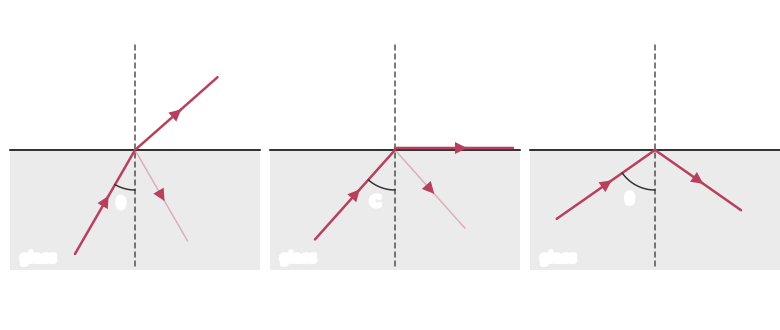
If the angle of incidence is greater than the critical angle, no light is refracted. All of it is reflected back inside the material. This is total internal reflection (TIR).
Sign in free to see the rest of this lesson, the R.E.C.I.P.E. recall steps and the quiz
BrainCake is free. Make an account in seconds and pick up where this page stops.
Key terms in this lesson
- refractive index
- A measure of how much a material slows down light, equal to the speed of light in a vacuum divided by its speed in the material.
More in Optics
- Refraction
- Snell's Law
- Investigating Refractive Index
- Dispersion
- Investigating Total Internal Reflection
- Applications of Total Internal Reflection
- Concave Lenses
- Convex Lenses
All 21 lessons in Optics · All Edexcel AS-level Physics topics