A convex lens is thicker at its centre than at its edges. It is a converging lens: it brings light rays together.Rays parallel to the principal axis are refracted by the lens and meet at a point on the axis on the other side, the principal focus F. Rays really pass through this point, so it is a real focus. The distance from the optical centre of the lens to F is the focal length f, which is positive in the real is positive convention. A lens has a principal focus on each side, the same distance from the centre.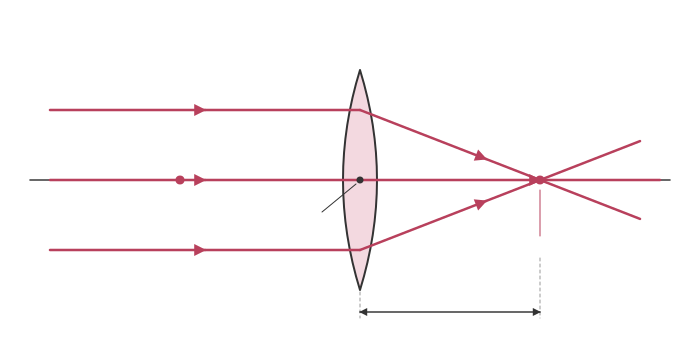
1. A ray parallel to the principal axis is refracted through the principal focus on the far side.
2. A ray through the optical centre passes straight through, undeviated.
3. A ray passing through the principal focus on the near side emerges parallel to the principal axis.In diagrams a convex lens is often drawn as a vertical line with outward-pointing arrowheads at each end.Finding f roughly: focus light from a distant object, such as a window across the room, onto a screen. The rays arriving are nearly parallel, so the distance from lens to sharp image is about the focal length. If sunlight is focused to a spot 20 cm from a lens, its focal length is 20 cm, which is 0.20 m.Convex lenses are used in magnifying glasses, cameras, projectors, the eye, and spectacles for long sight.