 BRAINCAKE
Dispersion
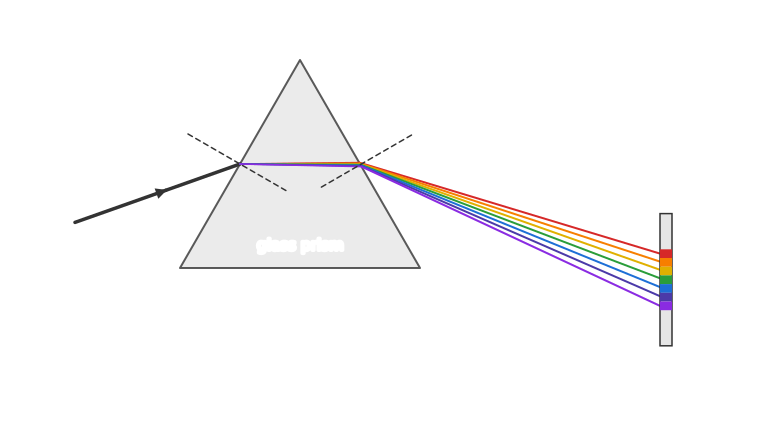
Dispersion is the splitting of white light into its separate colours, forming a spectrum.
It happens because the refractive index of a material such as glass depends slightly on the wavelength (colour) of the light. Violet light, with the shortest visible wavelength, is slowed down most, so it has the highest refractive index and is refracted the most. Red light, with the longest wavelength, is slowed least and refracted the least.
In a rectangular block the colours come out parallel again and overlap, so little splitting is seen. In a triangular prism the two refractions, one entering and one leaving, both bend the light the same way, so the colours spread out into a clear spectrum: red, orange, yellow, green, blue, indigo, violet.
Sign in free to see the rest of this lesson, the R.E.C.I.P.E. recall steps and the quiz
BrainCake is free. Make an account in seconds and pick up where this page stops.
Key terms in this lesson
- refractive index
- A measure of how much a material slows down light, equal to the speed of light in a vacuum divided by its speed in the material.
More in Optics
- Refraction
- Snell's Law
- Investigating Refractive Index
- Total Internal Reflection
- Investigating Total Internal Reflection
- Applications of Total Internal Reflection
- Concave Lenses
- Convex Lenses
All 21 lessons in Optics · All Edexcel AS-level Physics topics