This practical measures the refractive index of glass using a rectangular glass block and a ray box.Method:
1. Place the glass block on a sheet of white paper and draw round it.
2. Draw a normal at 90° to one long side, near the middle.
3. Use a ray box with a single narrow slit to aim a thin ray of light at the point where the normal meets the block, at a measured angle of incidence i.
4. Mark the incident ray and the ray leaving the far side with small crosses. Remove the block and join the crosses. Draw the refracted ray inside the block by joining the entry and exit points.
5. Measure the angle of refraction r from the normal with a protractor.
6. Repeat for a range of i, for example 10° to 70° in 10° steps.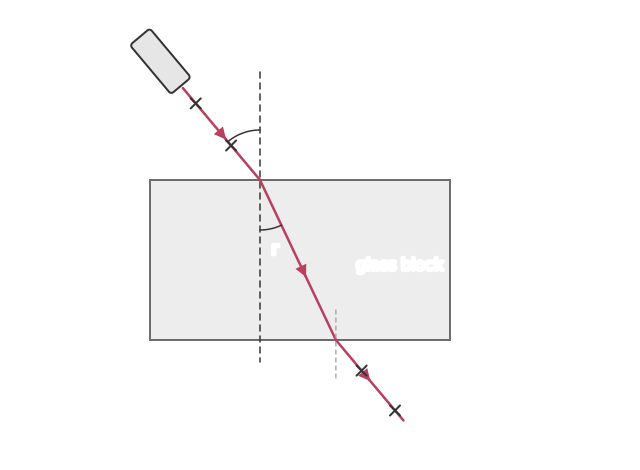
1. Place the glass block on a sheet of white paper and draw round it.
2. Draw a normal at 90° to one long side, near the middle.
3. Use a ray box with a single narrow slit to aim a thin ray of light at the point where the normal meets the block, at a measured angle of incidence i.
4. Mark the incident ray and the ray leaving the far side with small crosses. Remove the block and join the crosses. Draw the refracted ray inside the block by joining the entry and exit points.
5. Measure the angle of refraction r from the normal with a protractor.
6. Repeat for a range of i, for example 10° to 70° in 10° steps.