 BRAINCAKE
Investigating Total Internal Reflection
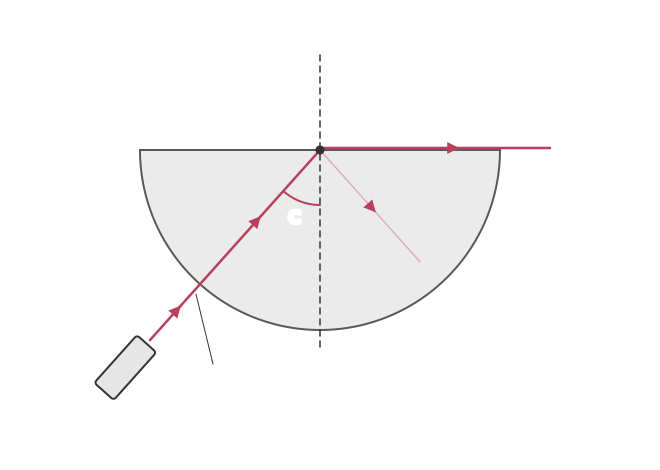
The critical angle of a material, and so its refractive index, can be measured using a semicircular glass block and a ray box.
Method:
1. Place the block on white paper, flat face away from the ray box, and draw round it. Mark the centre of the flat face.
2. Aim a narrow ray at the curved face so that it travels along a radius towards the centre of the flat face. Because it meets the curved surface along the normal, it enters without being refracted.
3. At the flat face the ray passes from glass to air. Move the ray box round, keeping the ray aimed at the centre, to increase the angle of incidence.
Sign in free to see the rest of this lesson, the R.E.C.I.P.E. recall steps and the quiz
BrainCake is free. Make an account in seconds and pick up where this page stops.
Key terms in this lesson
- critical angle
- The angle of incidence in the optically denser medium at which the angle of refraction is exactly 90 degrees, the onset of total internal reflection.
- refractive index
- A measure of how much a material slows down light, equal to the speed of light in a vacuum divided by its speed in the material.
More in Optics
- Snell's Law
- Investigating Refractive Index
- Dispersion
- Total Internal Reflection
- Applications of Total Internal Reflection
- Concave Lenses
- Convex Lenses
- The Power of a Lens
All 21 lessons in Optics · All Edexcel AS-level Physics topics