Glucose produced during photosynthesis contains energy absorbed from sunlight. The energy released from the breakdown of glucose is used to synthesise ATP, mostly by a process called chemiosmosis. A small amount of ATP is made directly by substrate-level phosphorylation, for example in glycolysis.Respiration is a multi-step pathway with enzymes catalysing each of the reactions. In the cell, the processes are continuous, but the first stage of respiration is called glycolysis.Glycolysis is an anaerobic process of 10 enzyme-catalysed reactions which occurs in the cytoplasm. Glucose is split into 2 pyruvate molecules and ATP and reduced nicotinamide adenine dinucleotide (NAD) are formed.
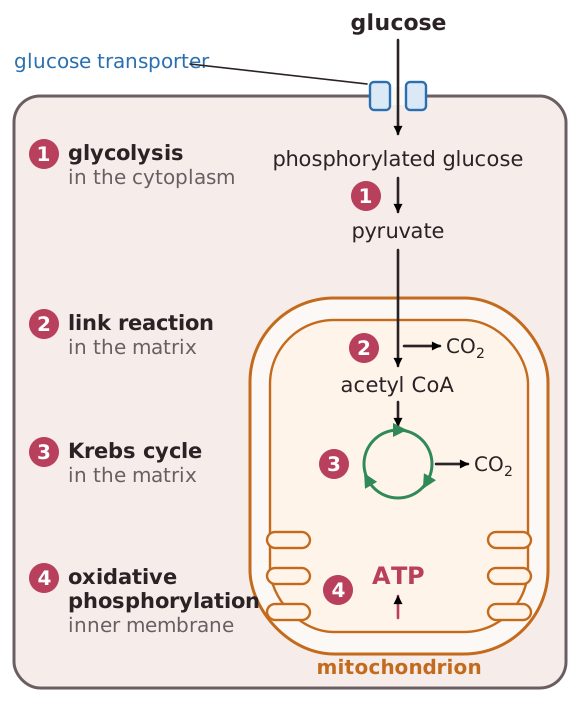
Energy from Glucose.
Read the text
Read the text and highlight anything you think is important. When you go on, the text is hidden and you answer from memory.
Specification: OCR Biology A (H420), A-level, 5.2.2 Respiration. Topic: Respiration.
Key terms in this lesson
- ATP
- Adenosine triphosphate, the universal energy currency of cells, which releases energy for cellular reactions when hydrolysed to ADP and inorganic phosphate.
- Chemiosmosis
- The synthesis of ATP by ATP synthase using the energy of a proton (hydrogen ion) gradient across a membrane.
More in Respiration
- Glycolysis
- Phosphorylation
- Lysis
- Substrate Level Phosphorylation
- The Link Reaction
- The Krebs Cycle.
- Oxidative Phosphorylation
- ATP Synthase
All 19 lessons in Respiration · All OCR A-level Biology topics