Pyruvate enters the mitochondria. There it undergoes decarboxylation, dehydrogenation by pyruvate dehydrogenase to form two-carbon acetate and carbon dioxide. The removal of carbon dioxide from pyruvate is called decarboxylation. Decarboxylation is accompanied by dehydrogenation the removal of hydrogen. The hydrogen reduces NAD to reduced NAD.The acetate reacts with coenzyme A (coA) to form acetyl coA.NAD is positive and the equation for the reduction can be written asNAD+ + H2 → NADH + H+ or just reduced NAD.
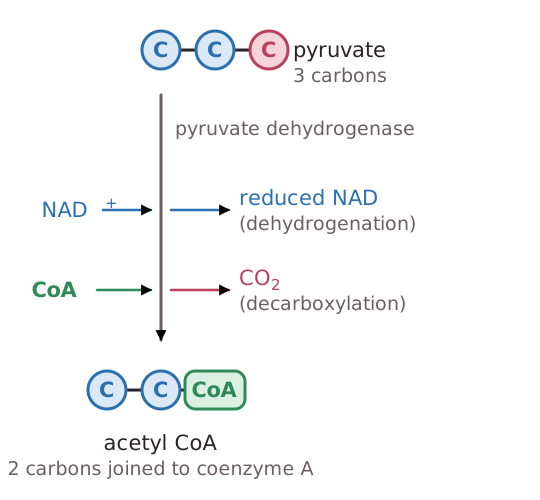
The Link Reaction
Read the text
Read the text and highlight anything you think is important. When you go on, the text is hidden and you answer from memory.
Specification: OCR Biology A (H420), A-level, 5.2.2 Respiration. Topic: Respiration.
Key terms in this lesson
- acetyl coenzyme a
- A 2-carbon compound formed from acetate and coenzyme A that enters the Krebs cycle to be oxidised for ATP production.
More in Respiration
- Glycolysis
- Phosphorylation
- Lysis
- Substrate Level Phosphorylation
- The Krebs Cycle.
- Oxidative Phosphorylation
- ATP Synthase
- Creatine Phosphate
All 19 lessons in Respiration · All OCR A-level Biology topics