Commercial growers use glasshouses (greenhouses) to control limiting factors, so crops photosynthesise faster, grow faster and give higher yields.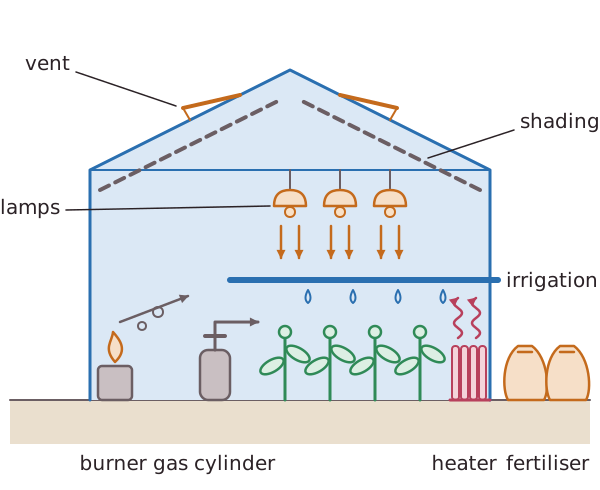 • Carbon dioxide: the concentration is raised from about 0.04% to around 0.1%, for example by burning paraffin or natural gas, or releasing pure carbon dioxide from cylinders. Burners also warm the air. Higher concentrations give little extra benefit and can close stomata.
• Light: glass lets light through, and artificial lighting extends day length and raises light intensity on dull days and in winter. Lamps are chosen to emit red and blue wavelengths, which chlorophyll absorbs best.
• Temperature: heaters keep the air near the optimum for the enzymes of the Calvin cycle (around 25 °C), and vents or fans stop it getting too hot, which would increase photorespiration and stomatal closure.
• Water and minerals: irrigation prevents water stress, and fertilisers supply nitrate and magnesium ions, needed to make amino acids and chlorophyll.Raising one factor only helps if it is the limiting factor. Once it is no longer limiting, another factor must also be raised, so growers adjust several factors together.Growers must weigh the cost of heating, lighting and carbon dioxide against the value of the extra yield. Worked example: if extra lighting costs £400 a week and raises yield by 150 kg of tomatoes sold at £2 per kg (£300), it is not worth using, because the cost exceeds the extra income by £100.
• Carbon dioxide: the concentration is raised from about 0.04% to around 0.1%, for example by burning paraffin or natural gas, or releasing pure carbon dioxide from cylinders. Burners also warm the air. Higher concentrations give little extra benefit and can close stomata.• Light: glass lets light through, and artificial lighting extends day length and raises light intensity on dull days and in winter. Lamps are chosen to emit red and blue wavelengths, which chlorophyll absorbs best.
• Temperature: heaters keep the air near the optimum for the enzymes of the Calvin cycle (around 25 °C), and vents or fans stop it getting too hot, which would increase photorespiration and stomatal closure.
• Water and minerals: irrigation prevents water stress, and fertilisers supply nitrate and magnesium ions, needed to make amino acids and chlorophyll.Raising one factor only helps if it is the limiting factor. Once it is no longer limiting, another factor must also be raised, so growers adjust several factors together.Growers must weigh the cost of heating, lighting and carbon dioxide against the value of the extra yield. Worked example: if extra lighting costs £400 a week and raises yield by 150 kg of tomatoes sold at £2 per kg (£300), it is not worth using, because the cost exceeds the extra income by £100.