The Krebs cycle also occurs in the matrix of the mitochondria. Acetyl coA reacts with 4-carbon oxaloacetate to form 6-carbon citrate and coA is released.Citrate undergoes decarboxylation and dehydrogenation to form 5-carbon alpha ketoglutarate (αKG). Carbon dioxide is released and NAD is reduced.αKG undergoes decarboxylation and dehydrogenation to form 4-carbon compound (succinyl coA). Carbon dioxide is released and NAD is reduced.The 4-carbon compound is converted back into 4-carbon oxaloacetate in 4 steps. ATP is made and FAD and then NAD is reduced in the process.
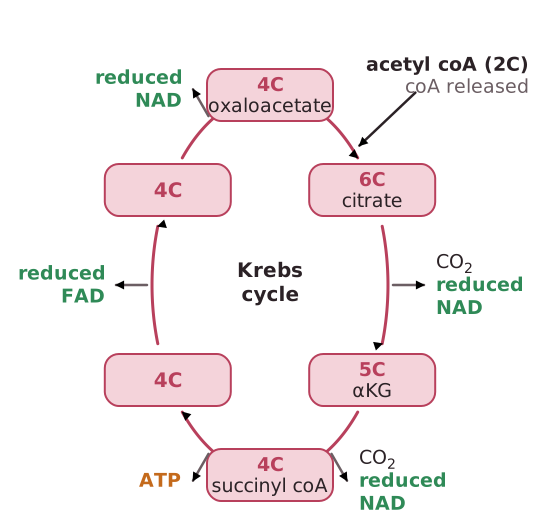
The Krebs Cycle.
Read the text
Read the text and highlight anything you think is important. When you go on, the text is hidden and you answer from memory.
Specification: OCR Biology A (H420), A-level, 5.2.2 Respiration. Topic: Respiration.
Key terms in this lesson
- ATP
- Adenosine triphosphate, the universal energy currency of cells, which releases energy for cellular reactions when hydrolysed to ADP and inorganic phosphate.
- Decarboxylation
- A reaction in which a carboxyl group is removed from a molecule, releasing carbon dioxide.
More in Respiration
- Phosphorylation
- Lysis
- Substrate Level Phosphorylation
- The Link Reaction
- Oxidative Phosphorylation
- ATP Synthase
- Creatine Phosphate
- Anaerobic Respiration - Plants and Microorganisms.
All 19 lessons in Respiration · All OCR A-level Biology topics