The production of ATP from ADP and inorganic phosphate using the energy from the proton gradient across the inner membrane of the mitochondria is called chemiosmosis.ATP synthase is a proton channel. The molecule has three identical subunits and a gamma subunit. As H+ ions pass through the hydrophilic pore the gamma subunit rotates, causing each of the three subunits in turn to go through three conformational changes. About three H+ ions are needed for each ATP made. The first allows the binding of ADP and inorganic phosphate. The second causes ATP to be produced and the third causes ATP to be released from the binding site.
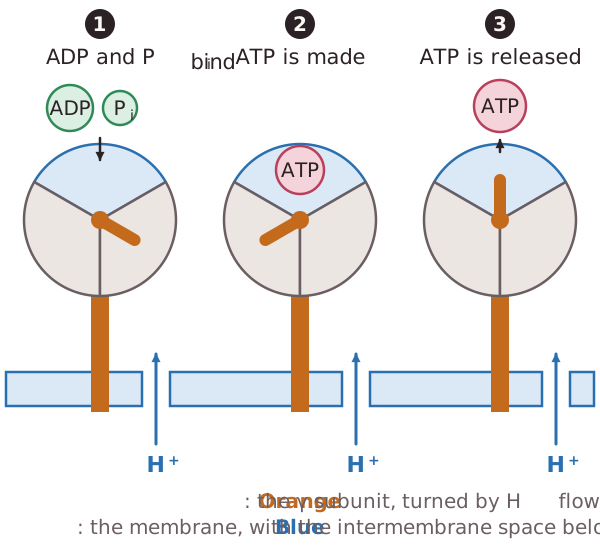
ATP Synthase
Read the text
Read the text and highlight anything you think is important. When you go on, the text is hidden and you answer from memory.
Specification: OCR Biology A (H420), A-level, 5.2.2 Respiration. Topic: Respiration.
Key terms in this lesson
- ATP
- Adenosine triphosphate, the universal energy currency of cells, which releases energy for cellular reactions when hydrolysed to ADP and inorganic phosphate.
More in Respiration
- Substrate Level Phosphorylation
- The Link Reaction
- The Krebs Cycle.
- Oxidative Phosphorylation
- Creatine Phosphate
- Anaerobic Respiration - Plants and Microorganisms.
- Anaerobic Respiration - Mammals
- Respiratory Substrates
All 19 lessons in Respiration · All OCR A-level Biology topics