The kidneys are covered by a thin, tough membranous capsule made of tough fibres of collagen and elastin. There are three main areas. The outer cortex which has a dense network of capillaries, the medulla which contains parts of the filtering and collecting units - nephrons - and the pelvis where urine collects before passing into the ureter.
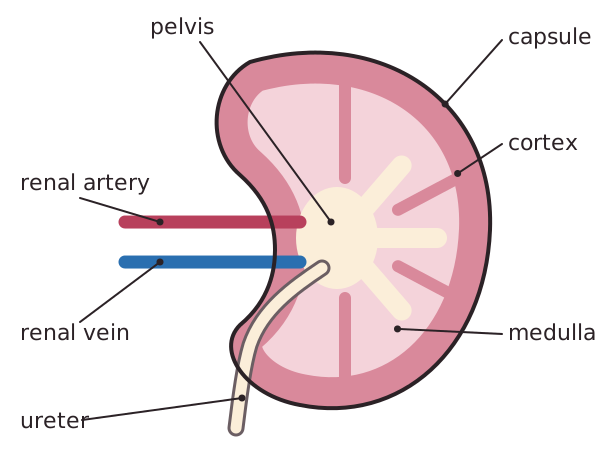
Structure of the Kidney
Read the text
Read the text and highlight anything you think is important. When you go on, the text is hidden and you answer from memory.
Specification: OCR Biology A (H420), A-level, 5.1.2 Excretion as an example of homeostatic control. Topic: Homeostasis.
Key terms in this lesson
- Neurone
- A specialised nerve cell adapted to transmit electrical impulses (nerve impulses) around the body.
- Neurotransmitter
- A chemical released from the presynaptic membrane at a synapse that diffuses across the synaptic cleft and binds to receptors on the postsynaptic membrane, triggering a response.
More in Homeostasis
- Transamination and Deamination
- Detoxification
- Production of Bile Salts, Bile Pigments and Cholesterol
- The Kidneys
- Nephrons
- Bowman's Capsule
- Glomerulus
- Proximal Convoluted Tubule
All 33 lessons in Homeostasis · All OCR A-level Biology topics