Selective reabsorption takes place in the proximal convoluted tubule. 85% of the filtrate is reabsorbed. Sodium-potassium pumps actively transport Na+ ions out of the epithelial cells on the capillary side. This creates a low Na+ concentration inside the cell. The cell surface membrane in contact with the filtrate has many microvilli and co-transporter proteins that transport Na+ associated with glucose or amino-acids from the lumen into the epithelial cells by facilitated diffusion. Once in the cell the glucose/amino-acids diffuse into the blood down their concentration gradient and are also actively transported. Water follows by osmosis.
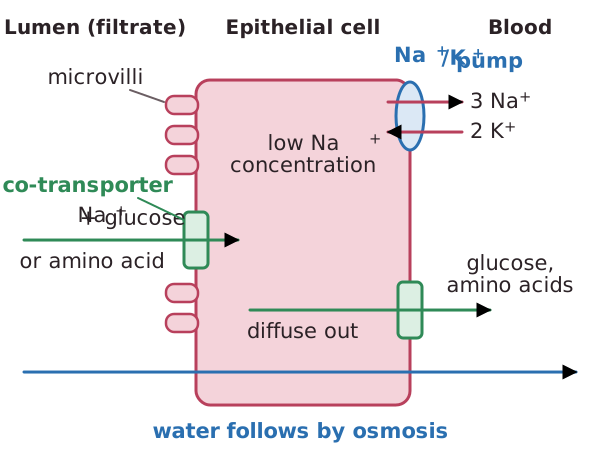
Proximal Convoluted Tubule
Read the text
Read the text and highlight anything you think is important. When you go on, the text is hidden and you answer from memory.
Specification: OCR Biology A (H420), A-level, 5.1.2 Excretion as an example of homeostatic control. Topic: Homeostasis.
Key terms in this lesson
- Neurone
- A specialised nerve cell adapted to transmit electrical impulses (nerve impulses) around the body.
- Action potential
- The temporary reversal of the electrical charge across an axon membrane, from about -70mV to +40mV, that occurs when a neurone is stimulated above threshold.
- Neurotransmitter
- A chemical released from the presynaptic membrane at a synapse that diffuses across the synaptic cleft and binds to receptors on the postsynaptic membrane, triggering a response.
More in Homeostasis
- Structure of the Kidney
- Nephrons
- Bowman's Capsule
- Glomerulus
- Loop of Henlé
- Countercurrent Multiplier
- Ultrafiltration, Selective Reabsorption and Osmoregulation.
- Distal Tubule and Collecting Duct
All 33 lessons in Homeostasis · All OCR A-level Biology topics