Skip to content

The Kidneys

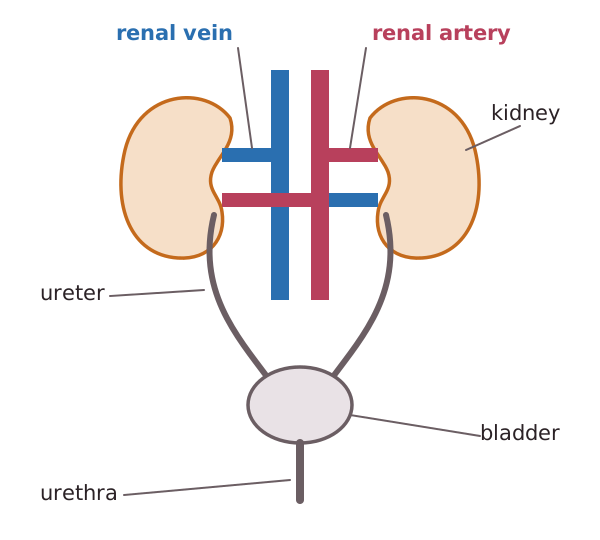
The kidneys are a pair of red-brown organs attached to the back of the abdominal cavity. They play a role in osmoregulation - regulation of water balance - and the excretion of nitrogenous waste such as urea.The kidney filters blood from the renal artery at a rate of 180dm3 a day. Blood is returned to the heart via the renal vein. The filtrate is collected by the collecting ducts and removed from the kidneys through the ureters and stored in the bladder. Urine passes out of the body through the urethra.
Read the text

Read the text and highlight anything you think is important. When you go on, the text is hidden and you answer from memory.

Specification: OCR Biology A (H420), A-level, 5.1.2 Excretion as an example of homeostatic control. Topic: Homeostasis.

Key terms in this lesson

Neurone
A specialised nerve cell adapted to transmit electrical impulses (nerve impulses) around the body.
Action potential
The temporary reversal of the electrical charge across an axon membrane, from about -70mV to +40mV, that occurs when a neurone is stimulated above threshold.
Depolarisation
A change in the potential difference across a membrane that makes the inside less negative, caused by an influx of sodium ions.

More in Homeostasis

All 33 lessons in Homeostasis · All OCR A-level Biology topics