 BRAINCAKE
Glomerulus
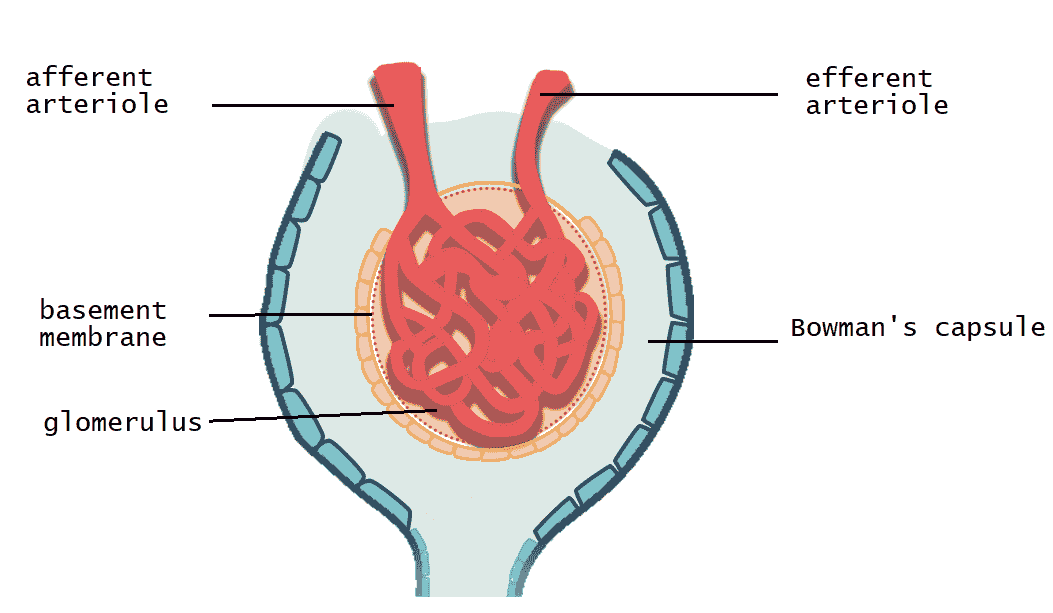
The glomerulus is a network of capillaries with many gaps between the capillary endothelial cells. Blood flows under hydrostatic pressure into the capillaries through the afferent arteriole, a branch of the renal artery, and flows out of the glomerulus through the efferent arteriole. The diameter of the afferent arteriole is larger than the diameter of the efferent arteriole. The difference in pressure forces blood plasma through the gaps into the lumen of the Bowman's capsule. This process is called ultrafiltration.
Sign in free to see the rest of this lesson, the R.E.C.I.P.E. recall steps and the quiz
BrainCake is free. Make an account in seconds and pick up where this page stops.
More in Homeostasis
- The Kidneys
- Structure of the Kidney
- Nephrons
- Bowman's Capsule
- Proximal Convoluted Tubule
- Loop of Henlé
- Countercurrent Multiplier
- Ultrafiltration, Selective Reabsorption and Osmoregulation.
All 33 lessons in Homeostasis · All OCR A-level Biology topics