 BRAINCAKE
Stationary Waves
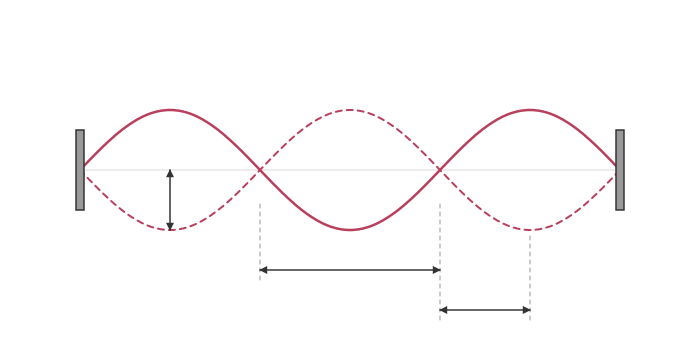
A stationary (standing) wave forms when two progressive waves with the same frequency and similar amplitude travel in opposite directions and superpose. This usually happens when a wave reflects back on itself, for example at the fixed end of a string.
The pattern does not move along. At some points the two waves always cancel. These are nodes, points of zero amplitude. Halfway between nodes the waves reinforce to give the largest oscillation. These are antinodes, points of maximum amplitude.
Sign in free to see the rest of this lesson, the R.E.C.I.P.E. recall steps and the quiz
BrainCake is free. Make an account in seconds and pick up where this page stops.
Key terms in this lesson
- progressive wave
- A wave that transfers energy away from a source through a medium, or vacuum, without transferring matter, as each particle oscillates about a fixed point.
- amplitude
- The maximum displacement of a point on a wave from its equilibrium, or rest, position.
More in Waves
- Phase and Phase Difference
- Superposition
- Interference
- Progressive Waves
- Demonstrating Stationary Waves
- Waves on a Stretched String
- Speed and Frequency of Waves on a Stretched String
- Investigating the Factors Affecting Fundamental Frequency
All 22 lessons in Waves · All Edexcel AS-level Physics topics