A string held under tension with both ends fixed, such as a guitar string, can carry stationary waves. In the lab a string runs from a vibration generator over a pulley, with masses hanging on the end to set the tension. The vibration generator is driven by a signal generator.Waves travel along the string and reflect at the ends. At certain frequencies the reflected and incident waves form a stationary wave with large amplitude. The ends of the string cannot move, so they are always nodes.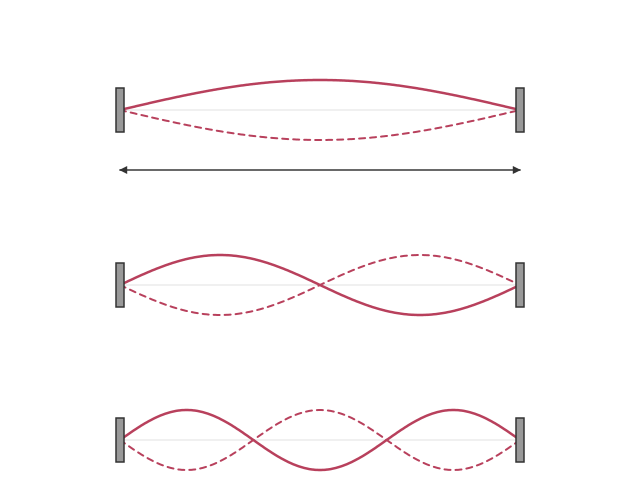
First harmonic (the fundamental): one loop, with a node at each end and one antinode in the middle. The string length l is half a wavelength, so λ = 2l.
Second harmonic: two loops, so l = λ and λ = l.
Third harmonic: three loops, so l = 3λ/2 and λ = 2l/3.In general, the nth harmonic has n loops andλ = 2l / n The wave speed on a given string at a fixed tension is constant, so since f = v/λ, the frequency of the nth harmonic is n times the frequency of the first: fn = nf1.Worked example: a string 0.60 m long vibrates in its third harmonic. λ = 2 × 0.60 / 3 = 0.40 m. If the first harmonic is at 100 Hz, the third is at 300 Hz.
First harmonic (the fundamental): one loop, with a node at each end and one antinode in the middle. The string length l is half a wavelength, so λ = 2l.
Second harmonic: two loops, so l = λ and λ = l.
Third harmonic: three loops, so l = 3λ/2 and λ = 2l/3.In general, the nth harmonic has n loops and