 BRAINCAKE
Demonstrating Stationary Waves
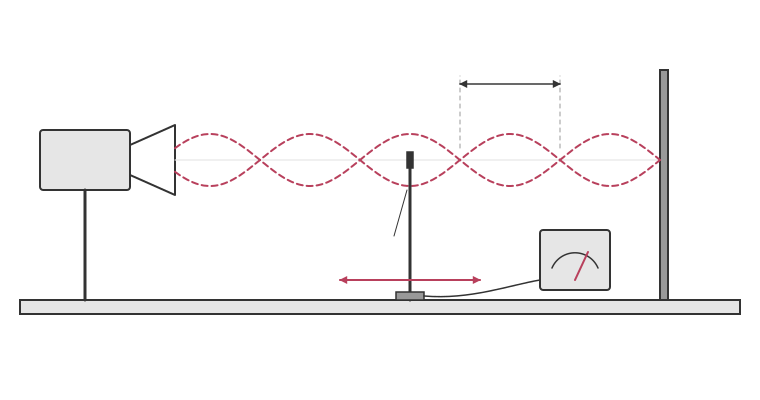
Stationary waves can be demonstrated, and used to measure wavelength, with microwaves or sound.
Microwaves: a microwave transmitter faces a flat metal plate, which reflects the microwaves straight back. The incident and reflected waves superpose to form a stationary wave between the transmitter and the plate. A microwave probe (detector) connected to a meter is moved slowly along the line between them. The reading rises and falls: it is a minimum at each node and a maximum at each antinode.
Sign in free to see the rest of this lesson, the R.E.C.I.P.E. recall steps and the quiz
BrainCake is free. Make an account in seconds and pick up where this page stops.
Key terms in this lesson
- node
- A point on a stationary wave where the amplitude is always zero.
- antinode
- A point on a stationary wave where the amplitude is at its maximum.
More in Waves
- Superposition
- Interference
- Progressive Waves
- Stationary Waves
- Waves on a Stretched String
- Speed and Frequency of Waves on a Stretched String
- Investigating the Factors Affecting Fundamental Frequency
- Fundamental Frequency
All 22 lessons in Waves · All Edexcel AS-level Physics topics