The power of a lens measures how strongly it converges or diverges light. A lens that bends light more has a shorter focal length and a greater power:P = 1 / f f must be in metres. The unit of power is the dioptre (D), which is equal to m-1.Using the real is positive convention:
A converging (convex) lens has a positive focal length, so it has a positive power.
A diverging (concave) lens has a negative focal length, so it has a negative power.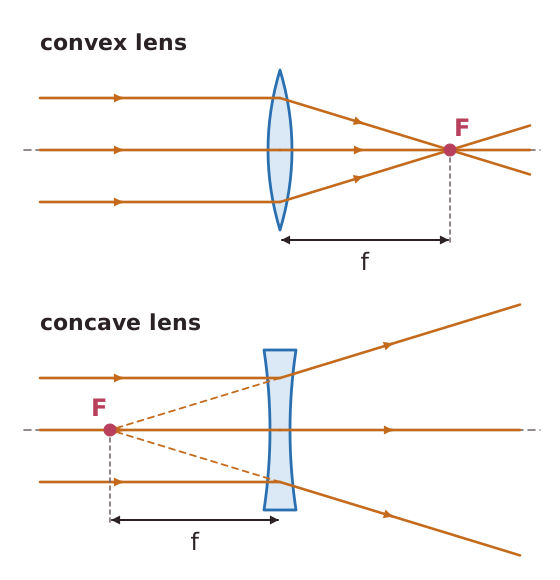 Thicker, more curved lenses have shorter focal lengths and so bigger powers (ignoring the sign). Opticians describe spectacle lenses by their power: a prescription of +2.0 D is a converging lens for long sight, while −3.0 D is a diverging lens for short sight.Worked example 1: a convex lens has a focal length of 25 cm. f = 0.25 m, so P = 1 / 0.25 = +4.0 D.Worked example 2: a lens has a power of −2.5 D. f = 1 / (−2.5) = −0.40 m. The negative sign shows it is a diverging lens with a focal length of 40 cm.Worked example 3: a magnifying glass has P = +10 D. f = 1 / 10 = 0.10 m = 10 cm.The most common mistake is to leave f in centimetres. A 25 cm lens is 4.0 D, not 0.04 D.
A converging (convex) lens has a positive focal length, so it has a positive power.
A diverging (concave) lens has a negative focal length, so it has a negative power.
Thicker, more curved lenses have shorter focal lengths and so bigger powers (ignoring the sign). Opticians describe spectacle lenses by their power: a prescription of +2.0 D is a converging lens for long sight, while −3.0 D is a diverging lens for short sight.Worked example 1: a convex lens has a focal length of 25 cm. f = 0.25 m, so P = 1 / 0.25 = +4.0 D.Worked example 2: a lens has a power of −2.5 D. f = 1 / (−2.5) = −0.40 m. The negative sign shows it is a diverging lens with a focal length of 40 cm.Worked example 3: a magnifying glass has P = +10 D. f = 1 / 10 = 0.10 m = 10 cm.The most common mistake is to leave f in centimetres. A 25 cm lens is 4.0 D, not 0.04 D.