Skip to content

Resolving Vectors at an Angle

Resolving a vector means splitting a vector into two component vectors at right angles to each other.
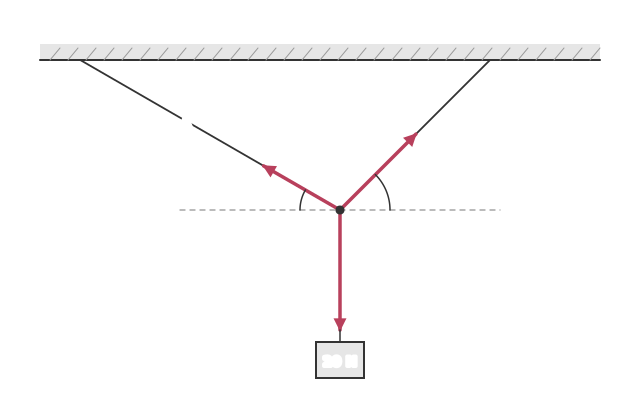
TA = 14.6N TB = 17.9NThese tensions answer the following problem. A 20 N weight hangs at rest from two strings. String A makes 30° with the horizontal and string B makes 45° with the horizontal. Find the tension in each string.The weight is in equilibrium, so the components of the forces must balance in every direction. Resolve each tension into horizontal and vertical components.Horizontally (left = right):
TA cos 30° = TB cos 45°
TB = TA × (0.866 ÷ 0.707) = 1.225 TA
Vertically (up = down):
TA sin 30° + TB sin 45° = 20
0.500 TA + (0.707 × 1.225 TA) = 1.366 TA = 20
TA = 14.6 N and TB = 1.225 × 14.6 = 17.9 N
The steeper string, B, carries the larger tension.The same method works for any direction: the component of a force F along a line at angle θ to it is F cosθ. For a weight W on a slope inclined at θ to the horizontal, the component down the slope is W sinθ and the component perpendicular to the slope is W cosθ.

Read the text

Read the text and highlight anything you think is important. When you go on, the text is hidden and you answer from memory.

Specification: Edexcel Physics (8PH0), AS-level, Topic 2: Mechanics, statement 13. Topic: Motion.

Key terms in this lesson

equilibrium
A state in which the resultant force and resultant moment on an object are both zero, so it has no tendency to accelerate or turn.

More in Motion

All 31 lessons in Motion · All Edexcel AS-level Physics topics