Resolving vectors means splitting a vector into two component vectors at right angles to each other.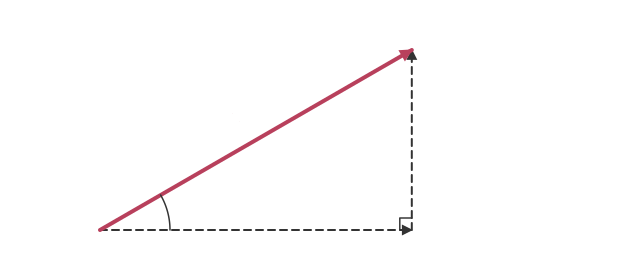
horizontal component Fx = F cosθ vertical component Fy = F sinθ The component next to the angle uses cos; the component opposite the angle uses sin.Worked example: a rope pulls a sledge with a force of 50 N at 30° above the horizontal.Fx = 50 cos 30° = 43 N Fy = 50 sin 30° = 25 N Only the 43 N horizontal component pulls the sledge forwards. The 25 N vertical component partly lifts the sledge, reducing the normal contact force from the ground.Components at right angles are independent: a vertical force has no effect horizontally. This is why resolving is so useful for projectiles and for objects on slopes.To recombine components, use Pythagoras for the size and tan-1(Fy ÷ Fx) for the angle. Check: √(43.32 + 252) = 50 N.