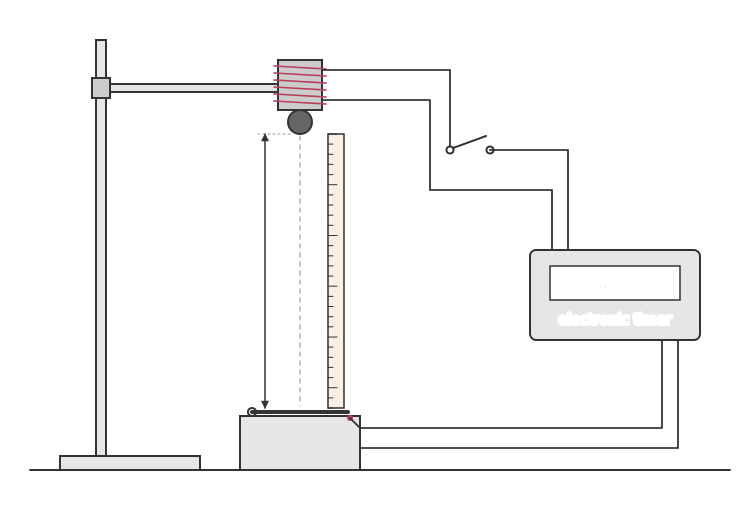
The acceleration due to gravity can be measured using the apparatus above.An electromagnet is used to hold a steel ball.When the electromagnet is switched off the steel ball drops and the time starts simultaneously.When the steel ball hits the trap door this breaks a circuit and the timer stops.The distance s from the electromagnet to the trap door is measured.The experiment is repeated with the steel ball at different heights and a graph of s against time2 is plotted.s = ½ gt2since ut = 0The gradient is g/2 so g is twice the gradient.Sources of error:random - height measured not perpendicularsystematic - electromagnet takes time to demagnetise and release the steel ball
Practical: Measuring g
The acceleration due to gravity can be measured using the apparatus above.An electromagnet is used to hold a steel ball.When the electromagnet is switched off the steel ball drops and the time starts simultaneously.When the steel ball hits the trap door this breaks a circuit and the timer stops.The distance s from the electromagnet to the trap door is measured.The experiment is repeated with the steel ball at different heights and a graph of s against time2 is plotted.s = ½ gt2since ut = 0The gradient is g/2 so g is twice the gradient.Sources of error:random - height measured not perpendicularsystematic - electromagnet takes time to demagnetise and release the steel ball
Read the text
Read the text and highlight anything you think is important. When you go on, the text is hidden and you answer from memory.
Specification: Edexcel Physics (8PH0), AS-level, Topic 2: Mechanics. Topic: Motion.
Key terms in this lesson
- systematic error
- An error that shifts every reading from the true value by the same amount or in the same direction, which averaging cannot remove.
- random error
- An error causing unpredictable, unbiased scatter in repeated readings around the true value, which can be reduced by repeating and averaging.
More in Motion
- Newton's Third Law of Motion
- Constant Acceleration
- Distance from Average Speed
- Constant Acceleration Formulae
- Constant Acceleration Question 1
- Constant Acceleration Question 2
- Resolving Vectors
- Resolving Vectors at an Angle
All 31 lessons in Motion · All Edexcel AS-level Physics topics