With a projectile, after the initial force which is used to set the object in motion, the only force of significance acting on the projectile is the force due to gravity.For example:A ball is dropped from a height of 5m.Calculate the speed at which it hits the ground.Calculate the time it takes to hit the ground.
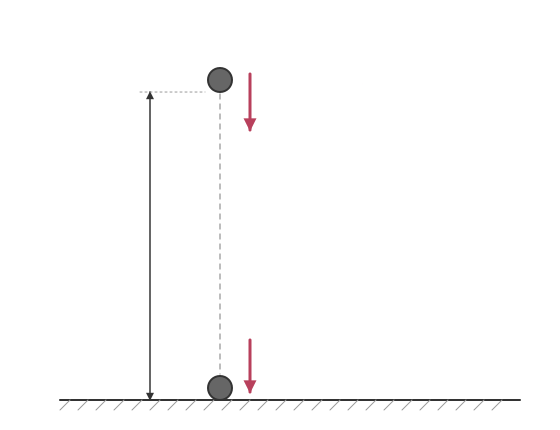
There is no horizontal motion so vertically you can use the constant acceleration formula s = ut + ½at2 since acceleration is constant and is equal to +g the acceleration due to gravity.Taking downwards as positive, u = 0 and a = g = 9.81 m s-2, so 5 = ½ × 9.81 × t2, giving t = 1.01 s.Then v = u + at = 9.81 × 1.01 = 9.9 m s-1.For an object thrown upwards, take upwards as positive: u is positive, a = -g, and v = 0 at the maximum height.
Vertical throws
Read the text
Read the text and highlight anything you think is important. When you go on, the text is hidden and you answer from memory.
Specification: Edexcel Physics (8PH0), AS-level, Topic 2: Mechanics, statement 15. Topic: Motion.
More in Motion
- Constant Acceleration Question 2
- Resolving Vectors
- Resolving Vectors at an Angle
- Projectile Motion
- Horizontal Throws
- Throwing Upwards and Forwards
- Projectile - Question 1
- Projectile - Question 2
All 31 lessons in Motion · All Edexcel AS-level Physics topics