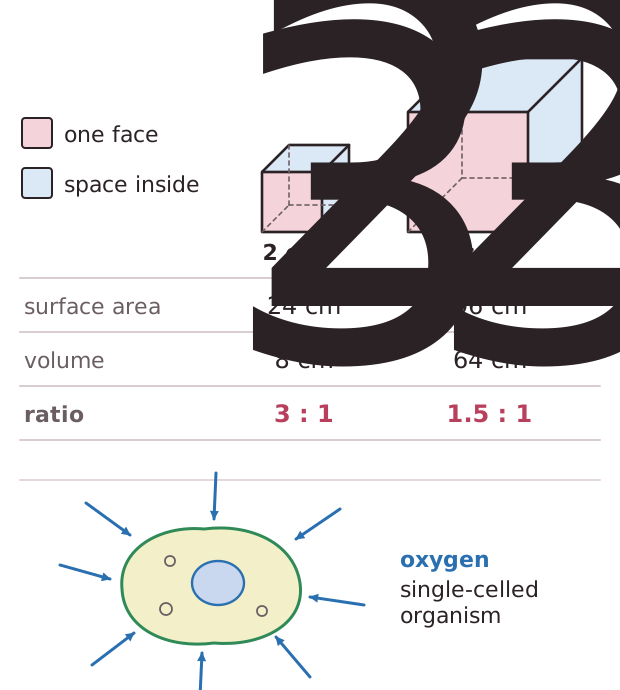
Every cell must take in oxygen and dissolved food and get rid of waste. In a single-celled organism this happens by diffusion straight across the cell surface. Such a cell has a large surface area compared with its volume, and its centre is never far from the surface, so diffusion alone is fast enough.
The surface area to volume ratio is found by dividing the surface area by the volume. As an organism gets larger, its volume grows faster than its surface area, so the ratio decreases. Take a cube with sides of 2 cm. Its surface area is 6 × 2 × 2 = 24 cm2 and its volume is 2 × 2 × 2 = 8 cm3, so the ratio is 24 : 8 = 3 : 1. For a cube with sides of 4 cm the surface area is 96 cm2 and the volume is 64 cm3, so the ratio falls to 1.5 : 1.
A multicellular organism has a small surface area to volume ratio, and most of its cells are deep inside the body. Diffusion across the skin alone would be far too slow to supply them. So large animals need specialised exchange surfaces, such as the alveoli in the lungs and the villi in the small intestine, which give a large surface area. They also need a transport system, the blood circulation, to carry substances between the exchange surfaces and the cells.