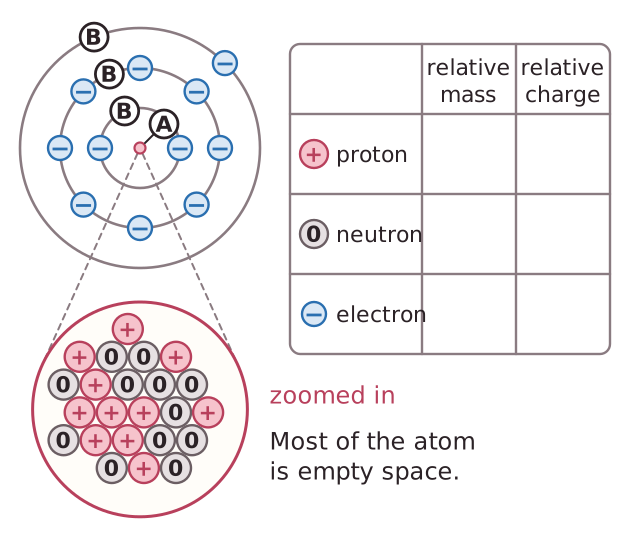
Every atom has a tiny nucleus at its centre. The nucleus contains two kinds of particle, protons and neutrons. Around the nucleus, electrons move in shells. Most of the atom is empty space.
The three particles are described by their relative mass and relative charge. A proton has a relative mass of 1 and a relative charge of +1. A neutron has a relative mass of 1 and no charge, so its charge is 0. An electron has a charge of -1, and its mass is so small that it is negligible compared with a proton.
Protons are positive and neutrons are neutral, so the nucleus is positive overall. An atom is neutral because it has the same number of protons and electrons. Their charges cancel and the total charge is zero. For example, a neutral atom with 11 protons has 11 electrons.