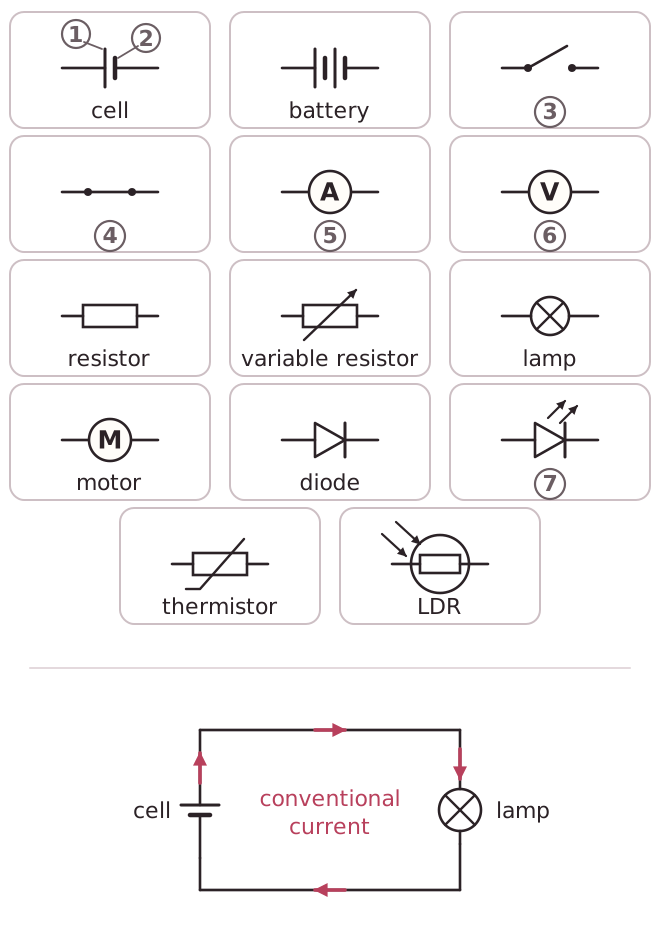
A circuit diagram uses standard symbols so that anyone can read it. A cell has a long line and a short line. The long line is the positive terminal and the short line is the negative terminal. A battery is two or more cells joined together. Conventional current is drawn leaving the positive terminal and returning to the negative terminal.
A switch is drawn as a gap that can be closed to complete the circuit. An ammeter is a circle containing the letter A and a voltmeter is a circle containing the letter V. A resistor is a rectangle, and a variable resistor is a rectangle with an arrow through it. A lamp is a circle with a cross inside, and a motor is a circle containing the letter M.
A diode is a triangle pointing at a bar, and current can only flow in the direction the triangle points. An LED is a diode with two arrows pointing away from it, because it gives out light. A thermistor is a resistor whose resistance changes with temperature. A light-dependent resistor, or LDR, is a resistor in a circle with arrows pointing towards it, because its resistance changes with light.