For simple molecules boiling temperatures are determined by the strength of the intermolecular force.For alkanes this is London forces.As the length of the carbon chain increases there are more points of contact so the overall force of attraction from London forces increases.As the molecular mass increases the number of electrons increases so the strength of the instantaneous dipoles and the induced dipoles increases.
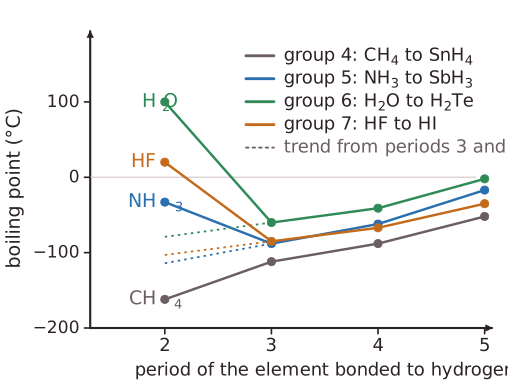
The group 4 hydrides have lower boiling points than the hydrides of groups 5 to 7 in the same period (but the rise is not steady, for example HCl boils below H2S). Group 4 hydrides are tetrahedral, non-polar covalent molecules such as methane. From group 5 to 7 the electronegativity increases and the molecules become more polar.
There are stronger dipole-dipole interactions. The hydrides in the same period have the same number of electrons, so their London forces are similar.
Water, hydrogen fluoride and ammonia do not follow the trends in boiling points of the hydrides of groups 4 to 7. This is because of hydrogen bonding between the molecules.
Branched alkanes have lower boiling temperatures than their straight chain isomers. There are fewer points of contact between adjacent molecules therefore there is a decrease in the overall intermolecular force.Alcohols have higher boiling temperatures than alkanes due to the hydrogen bonding. For the first few members of the homologous series hydrogen bonding is predominant, but as the chain length increases London forces predominate.The latent heat of vaporisation is a direct measure of the strength of an intermolecular bond because it is the energy required to break the intermolecular bonds and completely separate the molecules of a liquid and turn them into a gas.In the case of ethanol 15.7 kJmol-1 can be attributed to London forces and 22.9 kJmol-1 can be attributed to hydrogen bonds
The group 4 hydrides have lower boiling points than the hydrides of groups 5 to 7 in the same period (but the rise is not steady, for example HCl boils below H2S). Group 4 hydrides are tetrahedral, non-polar covalent molecules such as methane. From group 5 to 7 the electronegativity increases and the molecules become more polar.
There are stronger dipole-dipole interactions. The hydrides in the same period have the same number of electrons, so their London forces are similar.
Water, hydrogen fluoride and ammonia do not follow the trends in boiling points of the hydrides of groups 4 to 7. This is because of hydrogen bonding between the molecules.
Branched alkanes have lower boiling temperatures than their straight chain isomers. There are fewer points of contact between adjacent molecules therefore there is a decrease in the overall intermolecular force.Alcohols have higher boiling temperatures than alkanes due to the hydrogen bonding. For the first few members of the homologous series hydrogen bonding is predominant, but as the chain length increases London forces predominate.The latent heat of vaporisation is a direct measure of the strength of an intermolecular bond because it is the energy required to break the intermolecular bonds and completely separate the molecules of a liquid and turn them into a gas.In the case of ethanol 15.7 kJmol-1 can be attributed to London forces and 22.9 kJmol-1 can be attributed to hydrogen bonds