 BRAINCAKE
Polyatomic Ions
The carbonate CO32- and nitrate ions NO3- are trigonal planar as they both have three bonding regions of electron density surrounding the central atom.
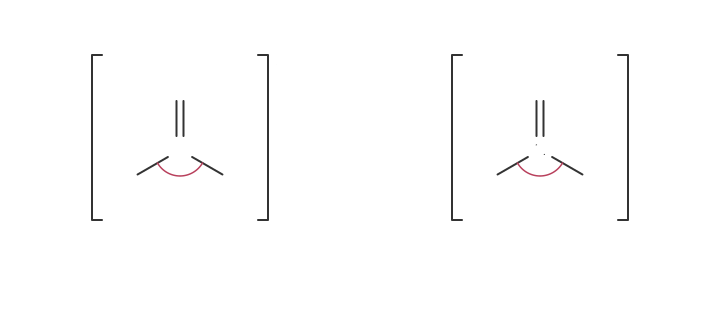
The shape of a polyatomic ion is predicted in exactly the same way as for a molecule: count the bonding regions and lone pairs around the central atom, then apply electron pair repulsion theory. The charge on the ion must be included when counting the electrons.
Sign in free to see the rest of this lesson, the R.E.C.I.P.E. recall steps and the quiz
BrainCake is free. Make an account in seconds and pick up where this page stops.
Key terms in this lesson
- electron pair repulsion theory
- Electron pairs around a central atom arrange themselves as far apart as possible to minimise repulsion, deciding molecular shape.
- lone pair
- A pair of outer shell electrons on an atom that is not involved in bonding.
- oxonium ion
- The ion H3O+, formed when a water molecule accepts a proton from an acid.
More in Discrete Molecules
- The Shapes of Molecules
- Molecules with Multiple Bonds
- Bond Angles
- Shape and Polarity
- London Forces
- Permanent Dipoles
- Hydrogen Bonds
- Intermolecular Forces and Boiling Points
All 25 lessons in Discrete Molecules · All Edexcel AS-level Chemistry topics