When a solid dissolves the ionic lattice breaks down or dissociates (endothermic) and the ions become hydrated (exothermic). The resulting enthalpy change is called the enthalpy of solution.The energy needed to break down the lattice into gaseous ions is equal in size but opposite in sign to the lattice energy, which Edexcel defines as the (exothermic) enthalpy change when one mole of the solid lattice forms from its gaseous ions.
The next stage involves the hydration of the gaseous ions. Energy is released when the ions form bonds with water molecules. This energy is the enthalpy change of hydration.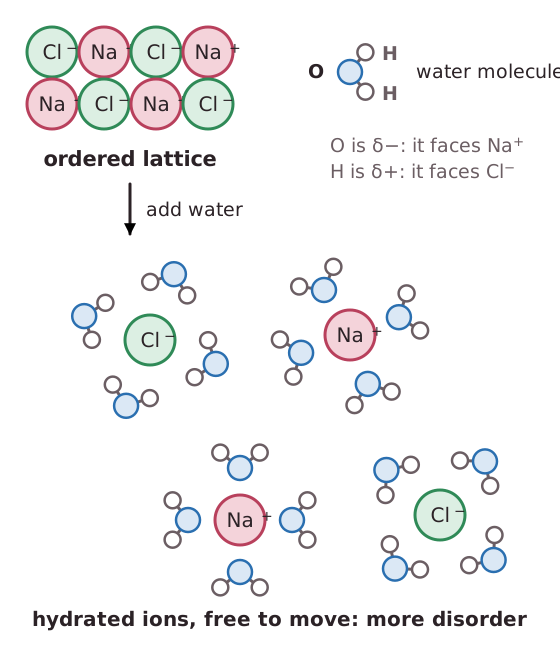
The next stage involves the hydration of the gaseous ions. Energy is released when the ions form bonds with water molecules. This energy is the enthalpy change of hydration.