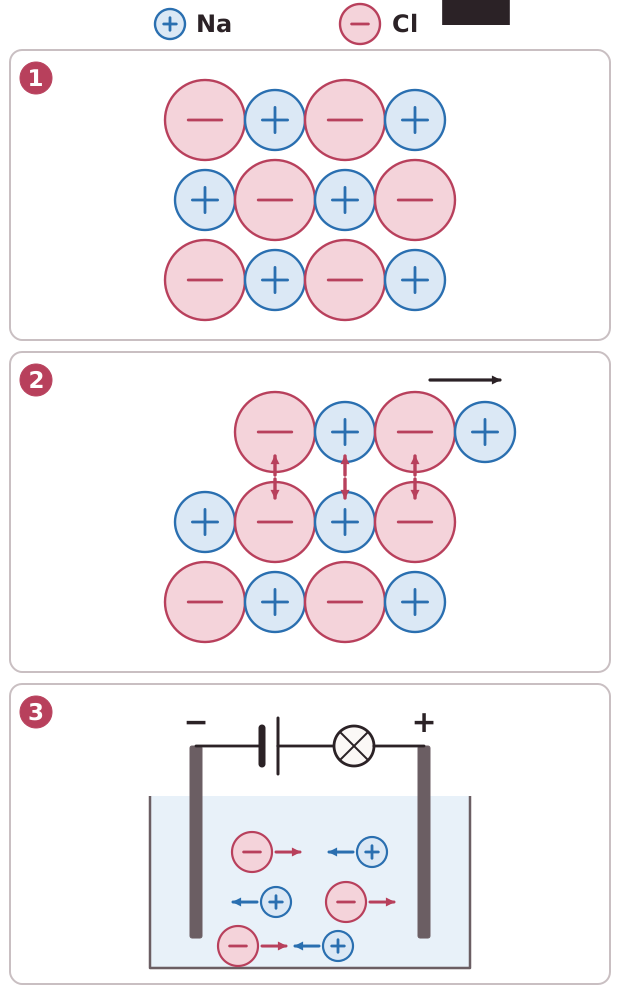
Ions attract oppositely charged ions in all directions resulting in a giant ionic lattice. An ionic bond is non-directional. Each ion is surrounded by ions of the opposite charge.
These strong electrostatic forces of attraction mean that ionic compounds have a high melting and boiling point. Almost all ionic compounds are solids at room temperature. Lattices containing ions with greater charges have higher melting points. The size of the electrostatic attraction is greater for smaller ions.
Many ionic compounds dissolve in polar solvents such as water. Water molecules attract and form bonds with the ions. Energy is required to break the bonds and dissociate the ions in the ionic lattice. This energy is taken from the surroundings or from the energy released in the formation of bonds between the solvent molecules and the ions. In the case of water this is known as hydration.
Ionic compounds do not conduct electricity in the solid state but conduct electricity when molten or in solution. This is because the ions can move and act as mobile charge carriers.