Benzene has the molecular formula C6H6. Its six carbon atoms form a flat (planar) hexagonal ring, with one hydrogen atom bonded to each carbon. Compounds that contain a benzene ring are called arenes or aromatic compounds; compounds without one are called aliphatic.Shape: each carbon is bonded to two carbons and one hydrogen, so the three bonding regions around each carbon are arranged in a trigonal planar shape with bond angles of 120°. All six carbon-carbon bonds are the same length.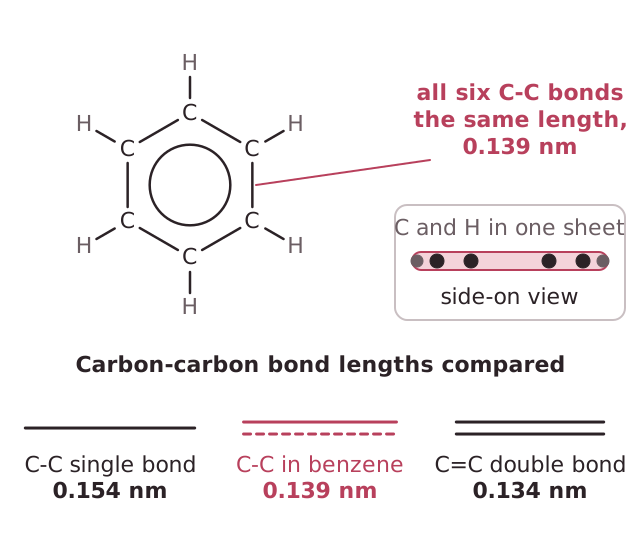 Benzene is usually drawn as a hexagon with a circle inside it. The circle represents a ring of delocalised electrons; the next lessons compare this with the older Kekulé structure.Naming arenes: many substituted benzenes use 'benzene' as the parent name, e.g. chlorobenzene C6H5Cl, nitrobenzene C6H5NO2 and methylbenzene C6H5CH3. When the ring is attached to a chain or functional group that gives the main name, the ring is called the phenyl group, C6H5, e.g. phenylethanone. Some have their own names, such as phenol C6H5OH and benzoic acid C6H5COOH. With two substituents, the ring carbons are numbered to give the lowest numbers, e.g. 1,4-dimethylbenzene.Properties: benzene is a colourless liquid (boiling temperature 80 °C) that is insoluble in water. It is carcinogenic, so schools use methylbenzene instead.Worked example: the empirical formula of benzene is CH. Its Mr = 6(12.0) + 6(1.0) = 78.0, so the percentage by mass of carbon is 72.0 ÷ 78.0 × 100 = 92.3%.