Three main pieces of evidence show that benzene is not the Kekulé structure and support the delocalised model.1. Bond lengths. X-ray diffraction shows that all six carbon-carbon bonds in benzene are the same length, 0.139 nm. This is between the length of a C-C single bond (0.154 nm) and a C=C double bond (0.134 nm), and the ring is a regular hexagon.2. Enthalpy of hydrogenation. Cyclohexene has one C=C bond:
C6H10 + H2 → C6H12 ΔH = −120 kJ mol−1
The Kekulé structure, with three C=C bonds, would therefore give ΔH = −360 kJ mol−1. The measured value for benzene is only −208 kJ mol−1.
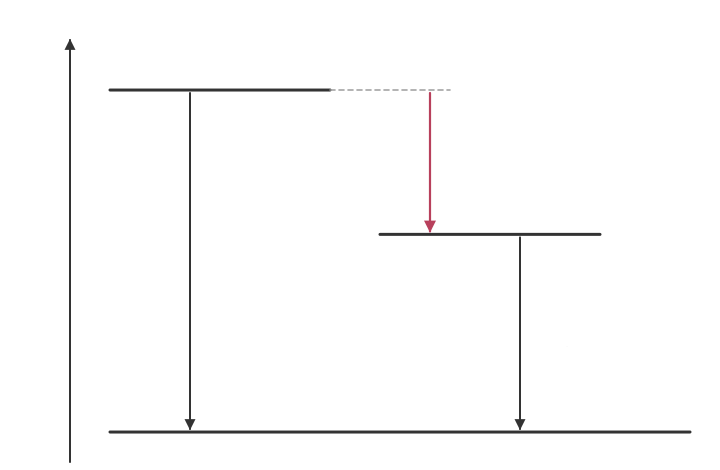
Benzene releases 360 − 208 = 152 kJ mol−1 less energy than predicted, so real benzene is 152 kJ mol−1 lower in energy (more stable) than the Kekulé structure. This extra stability is due to delocalisation.3. Resistance to addition. An alkene decolourises bromine water rapidly at room temperature by electrophilic addition. Benzene does not decolourise bromine water, and it reacts with bromine only when a halogen carrier catalyst is present, by substitution. Addition would destroy the stable delocalised system.Worked example: cyclohexa-1,3-diene has an enthalpy of hydrogenation of −232 kJ mol−1, close to 2 × (−120) = −240 kJ mol−1, because its two double bonds behave as ordinary alkene bonds. Benzene, at −208 kJ mol−1, is even less exothermic than this diene, even though it has three double bonds in the Kekulé structure.
The Kekulé structure, with three C=C bonds, would therefore give ΔH = −360 kJ mol−1. The measured value for benzene is only −208 kJ mol−1.