Friedel-Crafts alkylation substitutes an alkyl group onto a benzene ring, forming a new C-C bond. It is an electrophilic substitution.Reagents and conditions: a halogenoalkane (e.g. chloroethane) with an anhydrous aluminium chloride catalyst, AlCl3, heated under reflux. The conditions must be dry, because AlCl3 reacts with water.Generating the electrophile: AlCl3 is a halogen carrier. It accepts a lone pair from the chlorine atom of the halogenoalkane and removes it, forming a carbocation:
CH3CH2Cl + AlCl3 → CH3CH2+ + AlCl4− Mechanism: a pair of electrons from the delocalised ring bonds to the carbocation, forming a positive intermediate. The C-H bond then breaks, H+ is lost and the delocalised ring is restored.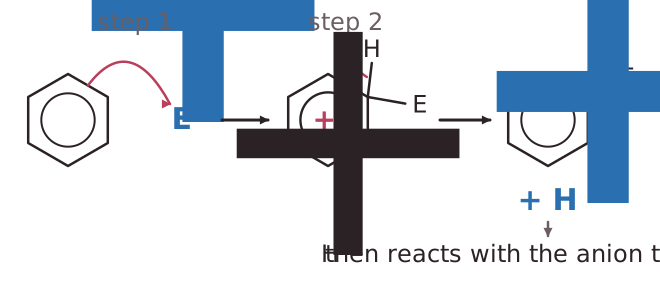 Regenerating the catalyst:
H+ + AlCl4− → AlCl3 + HCl Overall:
C6H6 + CH3CH2Cl → C6H5CH2CH3 + HCl
The product is ethylbenzene.Importance: it is a way of making C-C bonds to an aromatic ring. Ethylbenzene, for example, is converted into phenylethene, the monomer for poly(phenylethene).Limitation: an alkyl group makes the ring more reactive than benzene, so the product can be alkylated again, giving a mixture of di- and trisubstituted products. Using an excess of benzene reduces this.Worked example: to make methylbenzene, react benzene with chloromethane, CH3Cl, and AlCl3. The electrophile is CH3+, and the other product is HCl.
Regenerating the catalyst:The product is ethylbenzene.Importance: it is a way of making C-C bonds to an aromatic ring. Ethylbenzene, for example, is converted into phenylethene, the monomer for poly(phenylethene).Limitation: an alkyl group makes the ring more reactive than benzene, so the product can be alkylated again, giving a mixture of di- and trisubstituted products. Using an excess of benzene reduces this.Worked example: to make methylbenzene, react benzene with chloromethane, CH3Cl, and AlCl3. The electrophile is CH3+, and the other product is HCl.