Benzene reacts with bromine to form bromobenzene by electrophilic substitution.Conditions: liquid bromine with a halogen carrier catalyst such as iron(III) bromide, FeBr3, or iron filings (which react with bromine to make FeBr3), at room temperature. Aluminium bromide can also be used. Benzene does not react with bromine water, because Br2 on its own is not a strong enough electrophile to disrupt the delocalised ring.Overall:
C6H6 + Br2 → C6H5Br + HBr Generating the electrophile: the halogen carrier accepts a lone pair from a bromine atom, polarising the Br-Br bond until it breaks heterolytically:
Br2 + FeBr3 → Br+ + FeBr4− Mechanism:
• A pair of electrons from the delocalised ring bonds to Br+, forming a positive intermediate with a partly broken ring.
• The C-H bond breaks, its electrons restore the delocalised ring, and H+ is released.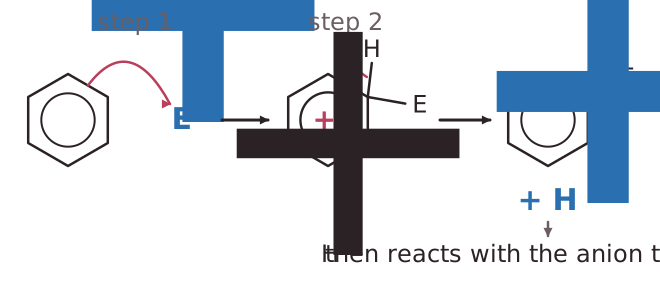 Regenerating the catalyst:
H+ + FeBr4− → FeBr3 + HBr
Misty fumes of HBr are given off and the red-brown colour of bromine fades.Chlorination works in the same way, using Cl2 with FeCl3 or AlCl3, to produce chlorobenzene.Worked example: 7.80 g of benzene (Mr = 78.0) is 0.100 mol. The ratio is 1 : 1, so the maximum amount of bromobenzene (Mr = 157) is 0.100 mol, a mass of 0.100 × 157 = 15.7 g.
• A pair of electrons from the delocalised ring bonds to Br+, forming a positive intermediate with a partly broken ring.
• The C-H bond breaks, its electrons restore the delocalised ring, and H+ is released.
Regenerating the catalyst:Misty fumes of HBr are given off and the red-brown colour of bromine fades.Chlorination works in the same way, using Cl2 with FeCl3 or AlCl3, to produce chlorobenzene.Worked example: 7.80 g of benzene (Mr = 78.0) is 0.100 mol. The ratio is 1 : 1, so the maximum amount of bromobenzene (Mr = 157) is 0.100 mol, a mass of 0.100 × 157 = 15.7 g.