A polyester is a condensation polymer in which the monomers are joined by ester links, COO. In condensation polymerisation, a small molecule (usually water) is lost each time two monomers join.To make a polyester you need monomers with two functional groups each:
• a dicarboxylic acid, HOOC-R-COOH
• a diol, HO-R'-OH
A COOH group of the acid reacts with an OH group of the diol, forming an ester link and eliminating H2O. Because every monomer has a reactive group at each end, the chain keeps growing. A diacyl chloride can be used in place of the dicarboxylic acid; then HCl is eliminated instead of water.Example: PET (Terylene) is made from benzene-1,4-dicarboxylic acid and ethane-1,2-diol:
n HOOCC6H4COOH + n HOCH2CH2OH → polymer + 2n H2O 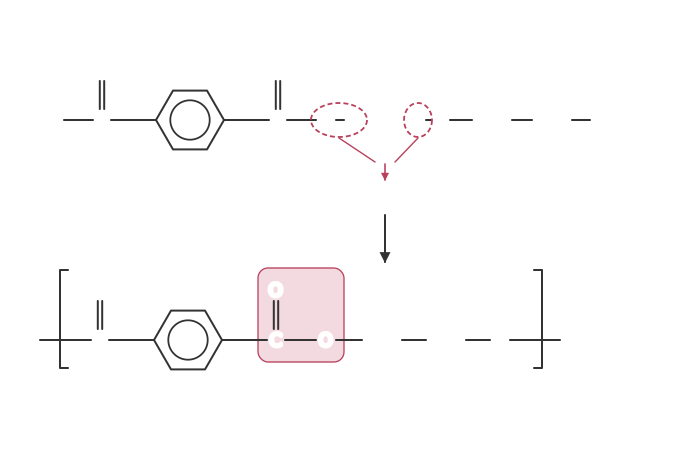
• a dicarboxylic acid, HOOC-R-COOH
• a diol, HO-R'-OH
A COOH group of the acid reacts with an OH group of the diol, forming an ester link and eliminating H2O. Because every monomer has a reactive group at each end, the chain keeps growing. A diacyl chloride can be used in place of the dicarboxylic acid; then HCl is eliminated instead of water.Example: PET (Terylene) is made from benzene-1,4-dicarboxylic acid and ethane-1,2-diol: