The amine group of one amino acid can react with the carboxylic acid group of another in a condensation reaction, eliminating a molecule of water. The new -CONH- group joining them is called a peptide link (it is an amide link).H2NCH2COOH + H2NCH(CH3)COOH → H2NCH2CONHCH(CH3)COOH + H2O Two amino acids joined together make a dipeptide. Because the product still has a free -NH2 at one end and a free -COOH at the other, more amino acids can join. Many joined together make a polypeptide, and a protein is one or more polypeptide chains folded into a specific shape. The sequence of amino acids in a chain is the primary structure.Two different amino acids can join in two ways, depending on which one provides the -COOH. Glycine and alanine give two different dipeptides, Gly-Ala and Ala-Gly.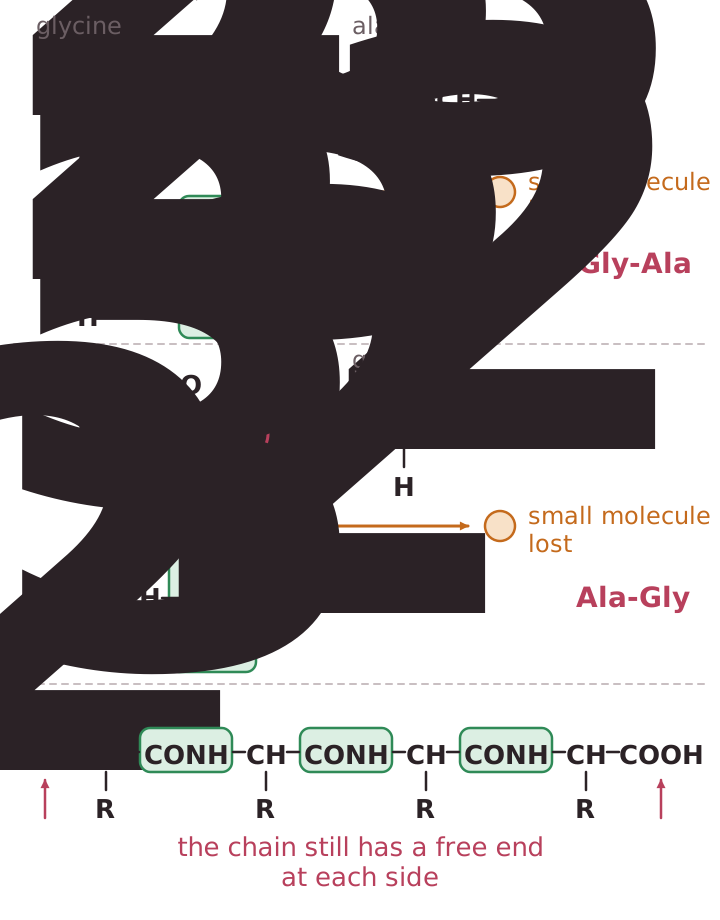 Hydrolysis. Peptide links can be broken by heating the protein under reflux with hydrochloric acid (about 6 mol dm-3) for around 24 hours. This hydrolysis is the reverse of condensation: water is added across each peptide link and the free amino acids are released (in acid they are present as their positive ions). Enzymes in the gut do the same at body temperature. The mixture of amino acids can then be identified by chromatography.Worked example: how many water molecules are eliminated when 50 amino acids form one polypeptide chain? A chain of n amino acids has n − 1 peptide links, so 50 − 1 = 49 water molecules are eliminated.