α-Amino acids contain an amine group, -NH2, and a carboxylic acid group, -COOH, both bonded to the same carbon atom (the α-carbon). Their general formula is RCH(NH2)COOH.About twenty different α-amino acids are used to build proteins, and they differ only in the side chain, R. In the simplest, glycine, R = H. In alanine, R = CH3. Side chains can be non-polar, polar, acidic or basic, which gives proteins their range of properties.Optical activity. In every α-amino acid except glycine, the α-carbon has four different groups attached (H, NH2, COOH and R), so it is a chiral centre. These amino acids exist as two enantiomers and are optically active: a solution rotates the plane of plane-polarised light. Glycine has two H atoms on its α-carbon, so it is not chiral. Amino acids from living things are almost all a single enantiomer.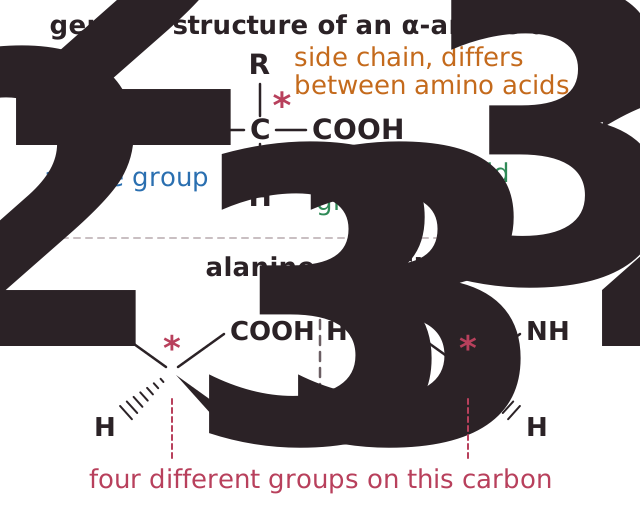 Acid and base properties. Amino acids are amphoteric: the -COOH group can donate a proton and the -NH2 group can accept one. So they react with both bases and acids.With aqueous sodium hydroxide, the carboxylic acid group is deprotonated:
H2NCH(CH3)COOH + OH− → H2NCH(CH3)COO− + H2O With hydrochloric acid, the amine group is protonated:H2NCH(CH3)COOH + H+ → +H3NCH(CH3)COOH The next lesson shows that in the solid, and in neutral solution, the two groups react with each other.
Acid and base properties. Amino acids are amphoteric: the -COOH group can donate a proton and the -NH2 group can accept one. So they react with both bases and acids.With aqueous sodium hydroxide, the carboxylic acid group is deprotonated: