Amines are Brønsted-Lowry bases: the lone pair on the nitrogen atom can accept a proton (H+). In water, an amine removes a proton from a water molecule, so the solution contains excess hydroxide ions and is alkaline:CH3CH2NH2 + H2O ⇌ CH3CH2NH3+ + OH− Like ammonia, amines are weak bases, so the equilibrium lies to the left. How strong a base is depends on how available the nitrogen lone pair is to accept a proton.Primary aliphatic amines are stronger bases than ammonia. Alkyl groups are electron-releasing (a positive inductive effect). They push electron density towards the nitrogen, so the lone pair is more available to accept a proton.Phenylamine is a much weaker base than ammonia. The nitrogen lone pair overlaps with the delocalised π system of the benzene ring and is partly delocalised into the ring. This lowers the electron density on the nitrogen, so the lone pair is less available to accept a proton.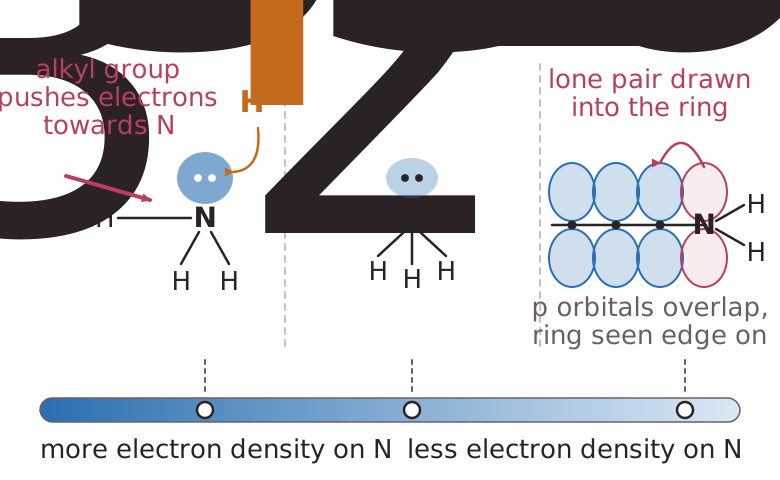 The order of base strength is therefore:
phenylamine < ammonia < ethylamine Worked example: rank butylamine, ammonia and phenylamine as bases. Butylamine has an electron-releasing alkyl group, so it is strongest; ammonia has no substituent; phenylamine's lone pair is delocalised, so it is weakest. Order: butylamine > ammonia > phenylamine.
The order of base strength is therefore: