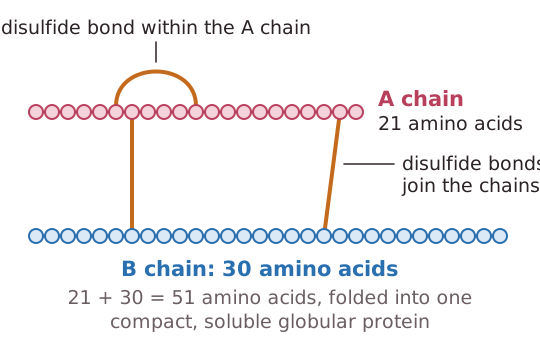
Insulin is a peptide hormone produced by the pancreas.It regulates the metabolism of carbohydrates, fats, and protein by promoting the absorption of glucose from the blood into cells of the liver, fat, and skeletal muscles and its conversion to glycogen.The human insulin protein is composed of 51 amino acids and has a quaternary structure as it is composed of two different subunits linked together by disulfide bonds.Insulin is a globular protein. It is transported in the bloodstream so needs to be soluble.The 3D shape of insulin is important for its function. The shape is complementary to the shape of its receptor on the cell surface membrane.
Read the text
Read the text and highlight anything you think is important. When you go on, the text is hidden and you answer from memory.
Specification: OCR Biology A (H020), AS-level, 2.1.2 Biological molecules. Topic: Biological Molecules.
Key terms in this lesson
- globular protein
- A water-soluble, roughly spherical protein folded so that hydrophilic R groups face outwards, such as an enzyme or haemoglobin.
More in Biological Molecules
- Polypeptides
- Protein Structure
- Hydrolysis of Peptides
- Globular Proteins
- Conjugated Proteins
- Haemoglobin
- Catalase
- Fibrous Proteins
All 63 lessons in Biological Molecules · All OCR AS-level Biology topics