 BRAINCAKE
Hydrolysis of Peptides
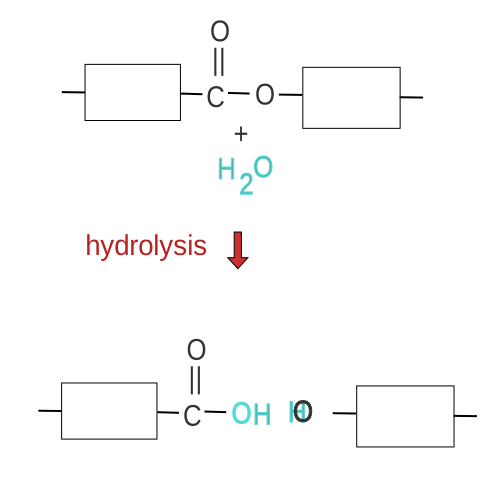
The peptide bonds in dipeptides, polypeptides and proteins can be broken by hydrolysis. A water molecule is added across each peptide bond: the -OH joins the carbon to reform a carboxyl group and the -H joins the nitrogen to reform an amine group.
Complete hydrolysis of a polypeptide gives its individual amino acids. Hydrolysis is the reverse of the condensation reaction that formed the peptide bonds.
Sign in free to see the rest of this lesson, the R.E.C.I.P.E. recall steps and the quiz
BrainCake is free. Make an account in seconds and pick up where this page stops.
Key terms in this lesson
- condensation reaction
- A reaction that joins two molecules together with a covalent bond, releasing a water molecule.
- hydrolysis
- A reaction that breaks a covalent bond between two molecules by adding a water molecule.
More in Biological Molecules
- Amino-acids
- Thin Layer Chromatography
- Polypeptides
- Protein Structure
- Globular Proteins
- Insulin
- Conjugated Proteins
- Haemoglobin
All 63 lessons in Biological Molecules · All OCR AS-level Biology topics