The amine group of one amino acid can react with the carboxylic acid group of another amino acid in a condensation reaction to join the two amino acids together in a dipeptide.A condensation reaction removes a water molecule from two monomers.When two amino acids are joined together in this way the bond formed is called a peptide bond.Several amino acids can be linked with peptide bonds to form a polypeptide.
This reaction is catalysed by the enzyme peptidyl transferase which is present in the large subunit of the ribosome.The oxygen atoms of the peptide bond can interact with hydrogen atoms of other peptide bonds. The R groups can also interact with each other.This leads to long chains of amino acids folding into complex structures called proteins.Different sequences of amino acids give different structures with different properties.
Two amino acids combine to form a dipeptide by a condensation reaction.A water molecule is removed to form a peptide bond.A peptide bond can be broken by hydrolysis.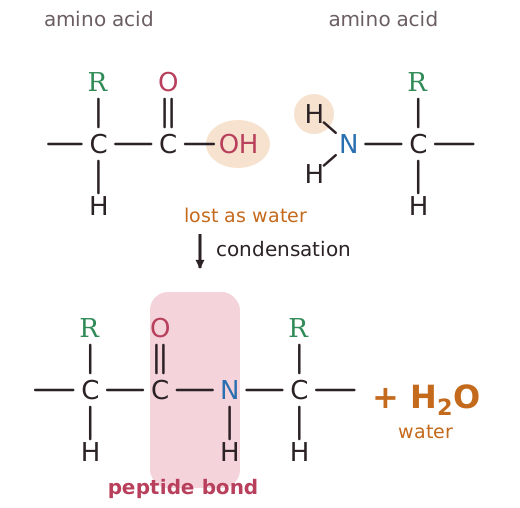
This reaction is catalysed by the enzyme peptidyl transferase which is present in the large subunit of the ribosome.The oxygen atoms of the peptide bond can interact with hydrogen atoms of other peptide bonds. The R groups can also interact with each other.This leads to long chains of amino acids folding into complex structures called proteins.Different sequences of amino acids give different structures with different properties.
Two amino acids combine to form a dipeptide by a condensation reaction.A water molecule is removed to form a peptide bond.A peptide bond can be broken by hydrolysis.